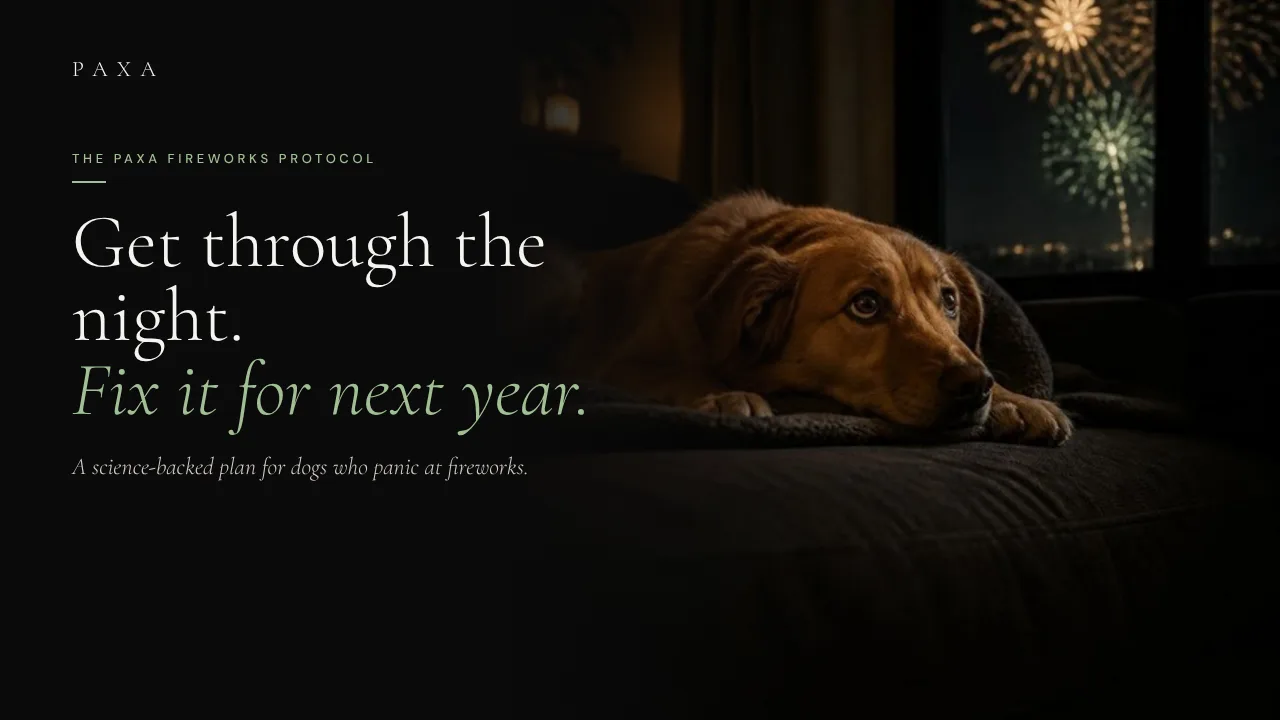
Most fireworks advice tells you not to comfort your frightened dog and to buy a calming chew. The research points the other way on both. Comfort does not make the fear worse, and in the largest owner survey on firework fear, calming products performed about as well as a placebo.
Bonfire Night falls on Thursday 5 November this year, and in most of the UK the bangs start days before and carry on until New Year. If your dog shakes, pants, hides or tries to bolt, this guide gives you two things: a plan for the night itself, and the method that actually reduces the fear for next season.
Everything below is built on published behavioural research, with sources linked so you can check them.
Quick answer: walk your dog in daylight, close curtains and windows, play steady background sound, give them a covered den, and stay home. Each time a firework bangs, give a high-value treat straight away. Comfort them calmly if they come to you. Then start a sound desensitisation programme in January to reduce the fear for next year.
Why fireworks frighten dogs so badly
A firework is the perfect threat signal: loud, sudden, unpredictable, and impossible to locate. To your dog's amygdala — the brain's threat detector — it looks like danger with no exit. The body responds with a stress cascade, and cortisol is the measurable part of it.
In a study led by Nancy Dreschel at Penn State, storm-phobic dogs listened to just a five-minute thunderstorm recording at home. Their cortisol rose by 207% on average, and it rose regardless of how their owners responded to them. That last detail matters: this is not a dog being dramatic or "playing up". It is a physiological alarm response.
It is also common. The PDSA's Animal Wellbeing Report estimated that 40% of UK dogs — around 3.6 million — are afraid of fireworks. In Stefanie Riemer's study of 1,225 dogs, published in PLOS ONE in 2019, 52% were at least partially affected, and most developed the fear in their first year of life.
Firework fear is not fixed. In Riemer's study, 39% of fearful dogs improved over time and 27% got worse. What the owner does decides which way it goes.
Should you comfort a dog scared of fireworks?
Yes. The old rule — "ignore them or you'll reward the fear" — misunderstands how fear works. Fear is an emotional state, not a trick your dog performs for attention. You cannot reinforce it by stroking a trembling dog, any more than holding a frightened child's hand teaches them to be scared.
UK welfare charities now say the same. The PDSA advises owners to offer normal comfort and never punish a frightened pet, and Wood Green's behaviour team states plainly that comfort will not make your dog more scared.
What does help less is anxious comfort: a high, worried voice, frantic fussing, or following a dog who has chosen to hide. Your dog reads your stress signals. Be the calm, boring, available presence in the room — a steady hand if they come to you, space if they want it.
A note if you have read our separation anxiety guides: the advice about keeping departures and returns low-key is about not making your coming and going a big event. It is a different situation. During fireworks, comfort is fine.
Do calming treats and diffusers work for fireworks?
This is where most owners spend their money, so it is worth being precise. In her follow-up study on the effectiveness of treatments for firework fears, Riemer compared what owners had actually tried. Pheromone products, nutraceuticals and other alternative remedies had similar success rates to one another — rates consistent with a placebo effect.
The three approaches that stood out were:
- Counter-conditioning — giving the dog something they love straight after each bang. Over 70% reported success, the highest of any training method.
- Relaxation training — a practised, conditioned settle on a mat or bed.
- Vet-prescribed medication — for dogs whose fear is severe.
Calming chews are not dangerous for most healthy dogs, and if one seems to take the edge off, there is no harm in it. The problem is what they replace. An owner who relies on a chew does nothing about the learned fear, and that fear can get worse each season. We cover the same pattern for separation anxiety in why calming treats don't fix the underlying problem. For the ingredient-by-ingredient evidence, see do dog calming treats work for fireworks.
The night plan, written out hour by hour.
PAXA Fireworks is a 28-page science-backed guide: a 72-hour countdown, an hour-by-hour plan for the night, and an 8-week sound programme for next season.
See the fireworks guide →Your Bonfire Night plan
You cannot cure a phobia in the next three weeks. You can make the night safer and stop it making next year worse. Work through this in order.
In the days before
Frightened dogs bolt. Check garden fences and gates, make sure your dog wears a collar and ID tag, and confirm the microchip details are current. This is the single most important safety step.
Pick the quietest room, ideally with no outside walls or windows facing the street. Set up a covered crate or a bed under a table with blankets over it. Leave it open, put treats and a chew in it daily, and let your dog discover it is a good place before the bangs start.
Test which food your dog will still take when slightly stressed — usually something soft and smelly like chicken, cheese or liver paste. Dry biscuits rarely work under fear. If your dog refuses food on the night, they are over threshold; switch to comfort and safety only.
If your dog has injured themselves, escaped or panicked for hours in previous years, ring your vet this week. Appointments fill up fast before 5 November. Never give a dog human medication.
On the night
- Walk early. Exercise and toilet your dog in full daylight. Do a final garden toilet trip before dusk, on a lead.
- Feed earlier than usual. A frightened dog often will not eat once the bangs start.
- Close everything. Curtains, windows, doors and cat flaps. This reduces both the noise and the flashes.
- Add steady background sound. TV, radio or white noise at a normal volume, started before the fireworks so it is not a new event.
- Stay home. Do not leave a noise-fearful dog alone on peak nights.
- Use the bang-then-treat rule. Every time a firework goes off, give a high-value treat or start a short game immediately after. The order matters: bang first, then the good thing. This is counter-conditioning — the method with the highest reported success in Riemer's data.
- Let your dog choose. If they hide, let them. Do not drag them out. If they come to you, offer calm contact.
Know the legal timings, so you know when it should end. In England and Wales, fireworks cannot be set off between 11pm and 7am, except on Bonfire Night, when the cut-off is midnight, and New Year's Eve, Diwali and Chinese New Year, when it is 1am.
If your dog won't go outside to toilet
Many firework-fearful dogs refuse the garden after dark, then hold it for hours. Plan the last toilet trip for just before dusk, when it is still quiet. If you have to go out later, keep your dog on a lead even in a secure garden, stand by the door rather than the far fence, and reward the moment they finish. Do not carry or drag a frozen dog outside. If there is an accident indoors, clean it up without comment — the PDSA lists toileting in the house as a normal sign of fear, not a training failure.
Can you leave a dog alone during fireworks?
Not on peak nights if you can avoid it. Dogs Trust advises staying home, because many dogs panic when frightened and alone. If you must go out, leave before dusk, set up the den and background sound first, and keep the trip short.
If being left is already hard for your dog on an ordinary evening, fireworks will stack two fears on top of each other. That is worth fixing in its own right. Start with velcro dog or separation anxiety: how to tell, then how long separation anxiety takes to fix.
Thundershirts, ear defenders and calming music
These are the products owners ask about most, so here is the honest picture:
- Pressure wraps (such as Thundershirts). The evidence is mixed. Some dogs seem calmer in one; many show no change. If you want to try one, put it on during calm evenings first so it is familiar, not a new thing that appears on a frightening night.
- Dog ear defenders. They can reduce the noise, but most dogs need days of practice with treats before they will wear them. Never fit them for the first time on Bonfire Night.
- Calming music and white noise. Useful as masking sound, which is why it is on the night plan. Dogs Trust has a free calming playlist made with Magic Classical. It softens the bangs; it does not change how your dog feels about them.
None of these harm a healthy dog. Treat them as extras on top of the plan, never as the plan.
The morning after
Most dogs recover quickly: in Riemer's study, almost three quarters had recovered by the next morning. But 12% took up to a week, and more than 3% took weeks or even months. If your dog is still hiding, refusing walks or startling at ordinary sounds days later, speak to your vet. That level of after-effect is a sign the fear needs proper treatment, not another season of coping.
Why is my dog shaking during fireworks — and when is it a red flag?
Shaking, panting, pacing, drooling, hiding, clinging and trying to escape are all normal signs of acute fear. They are unpleasant to watch, but on their own they are expected.
Treat these as reasons to see a vet:
- Your dog injures themselves — broken teeth, torn nails, cuts from doors or crates.
- They cannot settle for hours after the noise stops.
- The fear appeared suddenly in an older dog. Riemer found few dogs develop firework fear for the first time after the age of six or seven. New, late-onset noise sensitivity can be linked to pain, which makes a vet check the first step.
Noise fear also tends to travel with other anxiety. A 2001 clinical study in the Journal of the American Veterinary Medical Association reported that noise phobia and separation anxiety frequently occur together. If your dog also struggles when you leave the house, our guide to how to stop dog separation anxiety covers that side.
The long fix: changing how your dog hears a bang
Getting through the night is management. Changing the fear is training, and it uses the same two techniques that work for separation anxiety: systematic desensitisation and counter-conditioning.
In practice, that means playing firework recordings at a volume so low your dog notices but does not react, pairing every sound with food or play, and raising the volume in tiny steps over weeks. Each session stays below your dog's fear threshold. Push too far and you are flooding the dog — exposing them to the full fear — which tends to make noise phobia worse, not better. We explain how thresholds work in dog desensitisation training, step by step.
You do not need to buy recordings. Dogs Trust offers free firework sound files and how-to guides through its Sound Therapy for Pets programme, developed by veterinary behaviourists. What most owners lack is not the audio but the structure: where to start the volume, how long each session runs, when to move up and what to do after a bad day. That structure is what the PAXA Fireworks 8-week programme sets out, week by week.
Two honest points on timing:
- Do not start a full programme in the week of Bonfire Night. The real fireworks outside will keep pushing your dog over threshold and undo the work. Use the night plan now, then begin the sound programme in January, after New Year's Eve, so your dog has months of quiet to build on.
- Training works even after the fear has set in. In Riemer's study, dogs whose owners trained them after the fear developed were significantly more likely to improve.
If you have a puppy or a newly adopted dog, the same principle is preventive. Riemer found that teaching non-fearful dogs to associate loud noises with good things was highly effective at preventing firework fear later. See our guides to puppy behaviour and rescue dogs for how to approach those first months.
How to calm a dog during fireworks: frequently asked questions
How do I calm my dog during fireworks?
Walk and toilet your dog before dusk, close curtains and windows, play steady background sound, give them a covered den they can choose to use, and stay home with them. Each time a firework bangs, give a high-value treat or start a game they love straight away. In a survey of 1,225 dogs, this counter-conditioning was the training method owners rated most effective.
Should I comfort my dog during fireworks?
Yes. Calm, normal comfort does not reinforce fear. PDSA advises offering normal comfort and never punishing a frightened pet. Avoid anxious, frantic fussing, and let your dog hide if they want to.
Do calming treats work for dogs during fireworks?
The evidence is weak. In Riemer's research, pheromones, nutraceuticals and other alternative products had success rates consistent with a placebo effect. Counter-conditioning, relaxation training and vet-prescribed medication performed best.
When can fireworks be set off in the UK?
Not between 11pm and 7am, except on Bonfire Night (midnight) and on New Year's Eve, Diwali and Chinese New Year (1am). Your local council may have additional rules.
Can you stop a dog being scared of fireworks permanently?
Often it can be significantly reduced. Firework fear changes over time — 39% of fearful dogs in Riemer's study improved, and 27% got worse. Several weeks of sound desensitisation and counter-conditioning with recordings, kept below the fear threshold, is the standard method.
Can I leave my dog alone during fireworks?
Avoid it on peak nights such as 5 November and New Year's Eve — many dogs panic when frightened and alone. If you must go out, leave before dusk, set up the den and background sound first, and keep it short.
Do Thundershirts work for fireworks?
The evidence is mixed. Some dogs seem calmer in a pressure wrap; many show no change. Introduce it on calm evenings first, and treat it as an extra, not the plan.
When should I take my dog to the vet about firework fear?
If your dog injures themselves, tries to escape, cannot settle for hours afterwards, or the fear started suddenly in an older dog. Book before the season starts — appointments fill up fast in late October.
Key takeaways
- Comfort your dog. Calm comfort does not reinforce fear.
- Calming chews and diffusers are weak evidence. In the largest owner survey, they performed like a placebo.
- Bang first, then treat. Counter-conditioning on the night had the highest reported success.
- Safety before training. ID tag, current microchip, secure garden, daylight walks.
- The real fix starts after the season — weeks of sub-threshold sound training, begun in the quiet months.
- See your vet for injury, prolonged panic or sudden late-onset fear.
To go deeper: read the 40-minute rule on how cortisol peaks and settles, and our desensitisation guide for the method the sound programme is built on.
Educational guidance, not veterinary advice. If your dog is injured or in distress, contact your vet.
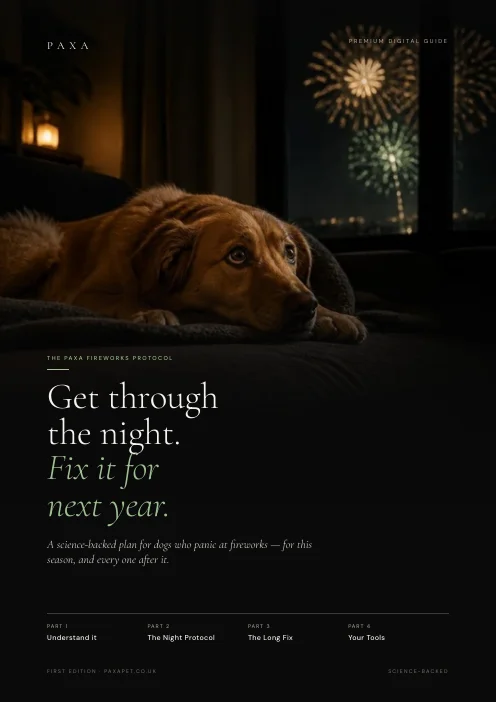
Get through the night. Fix it for next year.
PAXA Fireworks turns this research into a plan you can follow: a 72-hour countdown, an hour-by-hour night protocol with the bang-then-treat rule, and an 8-week desensitisation and counter-conditioning programme with threshold logs and trackers. 28 pages. Instant download.
Get the guide — £12 →Also struggling when you leave the house? Start the protocol — £29 →