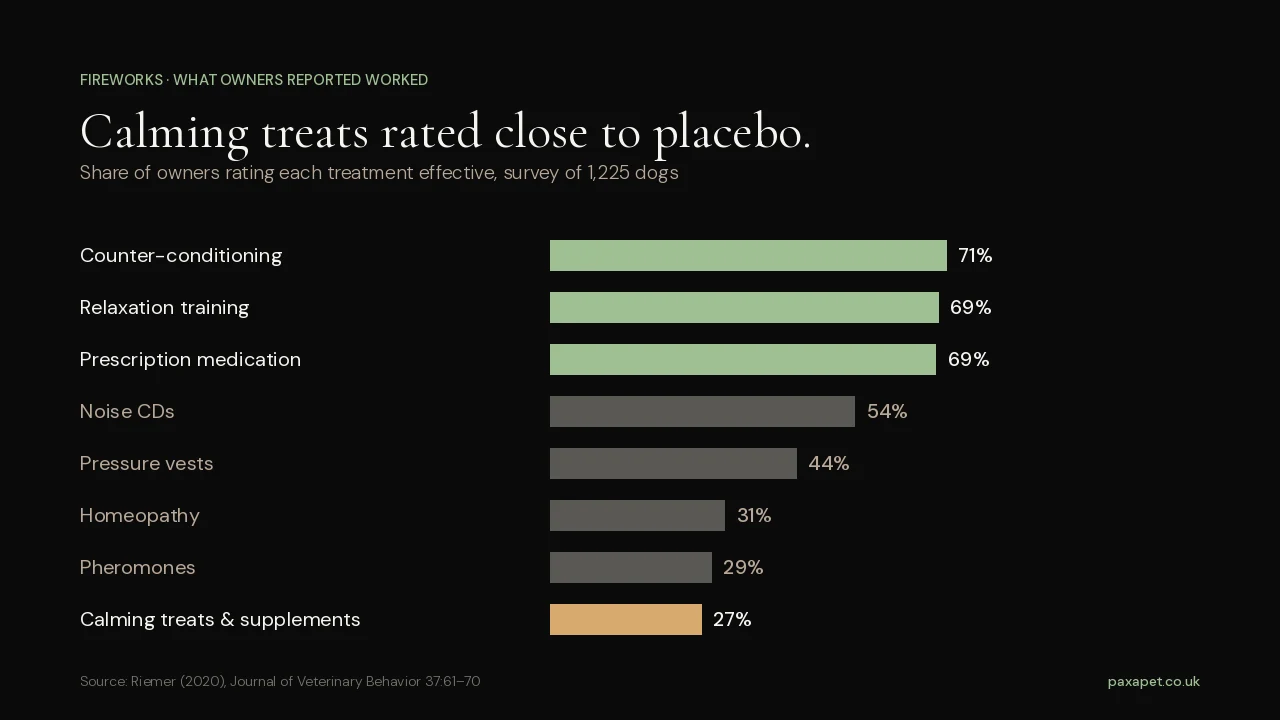
In the largest owner survey on firework fear, 27% of owners who used calming supplements said they worked. That sounds like something, until you learn it is about the success rate a placebo would produce. The products that sell best in October are not the ones that change how a dog hears a bang.
Searches for calming treats for fireworks climb sharply every autumn, and the shelves fill up to match. If you are standing in a pet shop this week deciding whether a tub of chews will get your dog through Bonfire Night, this is the evidence, ingredient by ingredient, with sources linked so you can check them.
The short version: calming treats are unlikely to harm a healthy dog, and unlikely to do much on the night. The methods with the highest reported success are not things you buy.
Quick answer: the evidence for calming treats during fireworks is weak. In a survey of 1,225 dogs, nutraceuticals were rated effective by 27% of owners and pheromones by 29%, close to placebo rates. Counter-conditioning (a treat straight after every bang), relaxation training and vet-prescribed medication were each rated effective by around 70%. If your dog's fear is severe, speak to your vet this week, not on the night.
What the biggest study on firework treatments found
In 2020, Stefanie Riemer at the University of Bern published the effectiveness of treatments for firework fears in dogs in the Journal of Veterinary Behavior. She surveyed owners of 1,225 dogs and asked which treatments they had tried and whether each one worked. These are the owner-reported success rates from the preprint of that study:
| Treatment | Rated effective | Owners who tried it |
|---|---|---|
| Counter-conditioning (treat or game after each bang) | 70.8% | 694 |
| Relaxation training | 69.3% | 433 |
| Prescription medication | 68.9% | 202 |
| Noise CDs (sound desensitisation) | 54.4% | 377 |
| Pressure vests and Thundershirts | 44.0% | 300 |
| Homeopathy | 31.2% | 250 |
| Pheromones (diffusers, collars, sprays) | 28.8% | 316 |
| Nutraceuticals (calming treats and supplements) | 27.0% | 211 |
Riemer's conclusion on the alternative products, from pheromones and supplements to herbal remedies and Bach flowers, was that their 27–35% success rates sit at roughly what you would expect from a placebo effect. Her conclusion on supplements specifically: there is too little research to recommend them.
This is survey data, so it shows association, not proof of cause. But the pattern is consistent: the three methods at the top change what a bang means to the dog or treat the fear medically. Calming treats do neither.
What is actually in calming treats
Most UK calming chews are built on the same short list of ingredients. Here is what the evidence looks like for each.
Ingredient 01
L-theanine
An amino acid from green tea, the active in Anxitane and many chews. A review of the veterinary studies found four, none placebo-controlled, most open-label and several funded by the manufacturer. One small trial tested it in 10 noise-phobic dogs alongside behaviour therapy, without blinding. Verdict: it may help, but there is no good trial showing that it does.
Ingredient 02
Alpha-casozepine
A milk protein extract, the active in Zylkène. An evidence review in Veterinary Evidence found three peer-reviewed dog studies, two industry-sponsored, all at high risk of bias. None tested it shortly before a sudden stressor such as fireworks. The review found no evidence it works as a same-day calmer, and only weak evidence of any longer-term benefit.
Ingredient 03
Tryptophan
A precursor to serotonin, often added to chews and calming diets. The study most often cited combined it with alpha-casozepine, so its own effect cannot be separated out. There is no trial of tryptophan alone for firework fear.
Ingredient 04
Chamomile, valerian and other botanicals
These sit in Riemer's alternative-remedies group, which as a whole performed at placebo-level rates. There are no controlled trials in dogs with noise fear that would justify relying on them.
None of these ingredients is a sedative, and none of them teaches the brain anything. At best they might take a small edge off. They do not touch the learned link between a bang and danger, and that link is the problem.
The plan that replaces the chew
A 72-hour countdown, an hour-by-hour night protocol, and the 8-week sound programme that changes next season.
See the fireworks guide →Why owners swear the treats work
If the evidence is this thin, why do so many reviews say a chew transformed their dog's Bonfire Night? Three reasons, none of which involve the chew.
- Caregiver placebo. The owner, not the dog, expects an effect, and reads the dog accordingly. Studies cited in Riemer's paper put the caregiver placebo effect in companion animals at 50–70%. In one placebo-controlled homeopathy trial she discusses, 65% of owners in the placebo group reported improvement, against 71% in the treatment group.
- Fireworks vary night to night. A quieter evening, a display further away or rain that cancels the neighbours' party looks exactly like a product working.
- The owner changes too. Buying something feels like taking control. A calmer owner who closes the curtains early and stays in is doing several things that genuinely help, and the chew gets the credit.
The real cost is not the price of the tub
Calming treats are not dangerous for most healthy dogs. The cost is what they replace. Firework fear is not static: in Riemer's earlier PLOS ONE study of the same population, 39% of fearful dogs improved over time and 27% got worse. Dogs whose owners trained them after the fear appeared were significantly more likely to improve.
Each frightening night is a learning trial. The amygdala, the brain's threat detector, files the bang as danger again, and the association strengthens. An owner who relies on a chew every November and does nothing in between is, in effect, scheduling the same fear rehearsal every year. It is the same pattern we see with separation anxiety, covered in why calming treats don't fix the underlying problem.
A calming treat is a decision about tonight. Firework fear is a problem about every season to come.
If you still want to use one: four rules
- Try it on a calm evening first. Check your dog eats it and has no stomach upset before the first big night.
- Check with your vet if your dog takes any medication or has a health condition. "Natural" does not mean it cannot interact.
- Follow the label, not a forum. Products vary in dose and timing, and no timing has good evidence behind it.
- Treat it as an extra, never the plan. The night plan below does the real work.
What actually works on the night
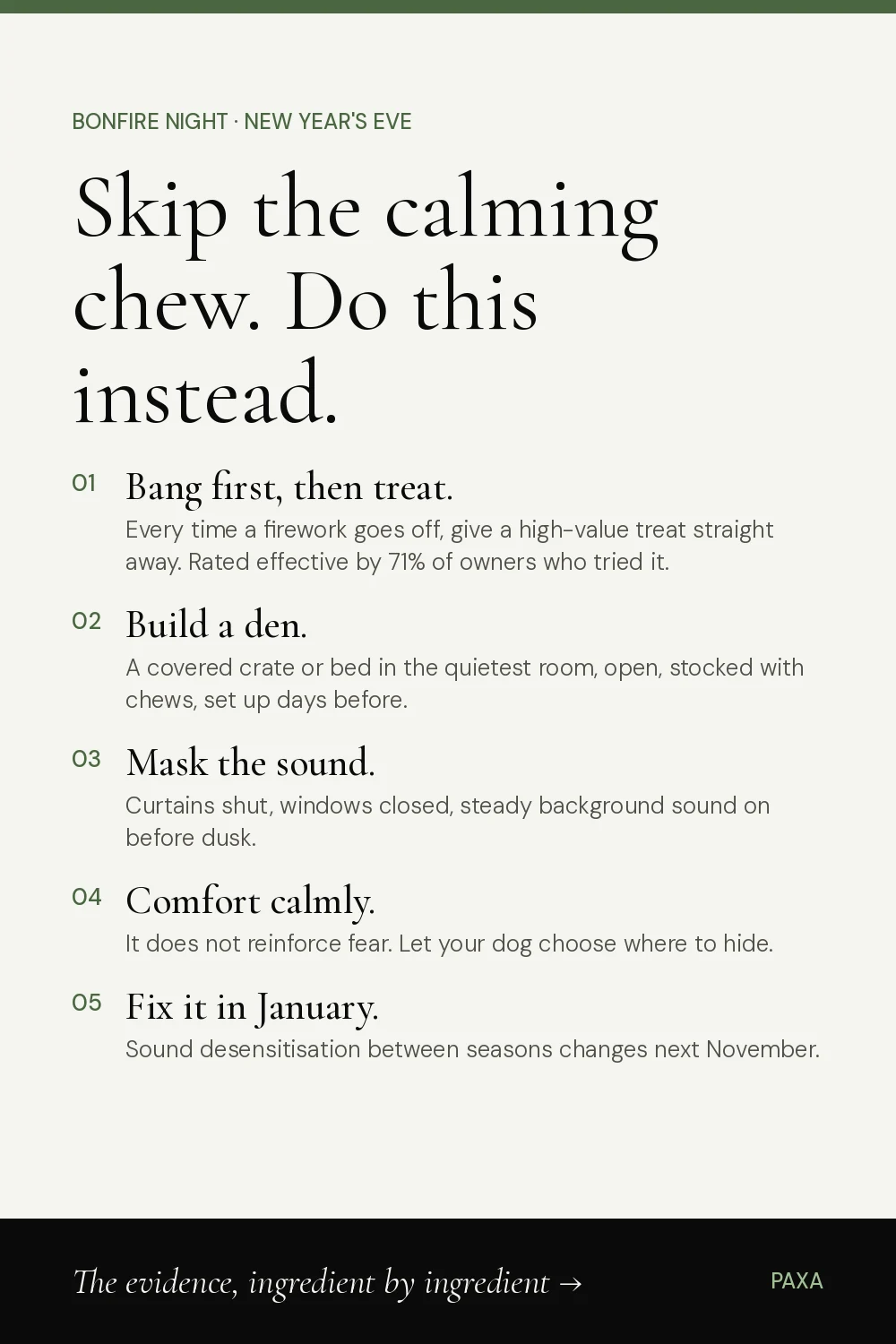
The top-rated method in Riemer's data costs nothing: each time a firework bangs, give your dog a high-value treat or start a short game straight away. Bang first, then the good thing. That order is what turns a threat signal into a predictor of something good. It is counter-conditioning, and it was rated effective by 70.8% of owners who used it.
Around that rule, the basics: walk and toilet your dog in daylight, close curtains and windows, play steady background sound, give them a covered den they can choose to use, and stay home. Let your dog come to you for comfort, and offer it calmly. Comforting a frightened dog does not reinforce fear. The full hour-by-hour plan is in our guide to how to calm a dog during fireworks.
When to ask your vet about medication
Prescription medication sat alongside counter-conditioning at the top of Riemer's results. If your dog trembles for hours, tries to escape, injures themselves or has not recovered by the next morning, that is a reason to book a vet appointment now, before the peak nights, rather than reaching for another chew.
In the UK, a gel called Sileo (dexmedetomidine) is licensed for noise-related anxiety and fear in dogs. It is prescription-only (POM-V), so your vet decides whether it or another medication suits your dog. Never give your dog human medication to calm them.
The long fix: change what a bang means
Treats, diffusers and medication manage a night. Only training changes the next season. The standard method is sound desensitisation combined with counter-conditioning: play firework recordings at a volume low enough that your dog stays relaxed, pair them with food and play, and raise the volume in small steps over several weeks. Each calm session is a new learning trial, this time with the right outcome.
Two things decide whether it works. Staying below the fear threshold, so the dog is never frightened during practice. And structure: where to start the volume, how long each session runs, when to move up and what to do after a setback. That structure is what the PAXA Fireworks 8-week programme sets out, week by week. Start in January and your dog meets next November with eight weeks of new learning behind them.
Calming treats for fireworks: frequently asked questions
Do calming treats work for dogs during fireworks?
The evidence is weak. In a survey of 1,225 dogs, calming supplements were rated effective by 27% of owners who used them, about the rate expected from a placebo. Counter-conditioning, relaxation training and vet-prescribed medication were each rated effective by around 70%.
What is the best calming treat for dogs scared of fireworks?
No calming treat has strong evidence for fireworks. The most common actives, L-theanine and alpha-casozepine, have only small, mostly industry-funded studies, and none tested them as a same-day calmer before fireworks. The best-rated approaches in research are not products: a treat straight after each bang, and sound desensitisation in the months between seasons.
How long before fireworks should I give a calming treat?
Follow the product label. There is no good evidence for any particular timing, and the review of alpha-casozepine found no evidence it works when given shortly before a stressor. Try any new product on a calm evening first.
Are calming treats safe for dogs?
Most are unlikely to harm a healthy dog, but check with your vet if your dog takes medication or has a health condition. The main risk is not the treat itself but relying on it instead of a plan that reduces the fear.
Do plug-in diffusers work for fireworks?
In Riemer's survey, 28.8% of owners who used pheromone products rated them effective, and she concluded there is little evidence they calm dogs afraid of fireworks. They will not harm your dog, but they should not be the plan.
What can a vet prescribe for firework fear in the UK?
Sileo, a dexmedetomidine gel, is licensed in the UK for noise-related anxiety and fear in dogs and is prescription-only. Your vet may consider it or other medication depending on your dog's health. Book before the peak nights, and never give human medication to a dog.
Key takeaways
- Calming treats rated close to placebo. 27% reported success, against around 70% for the top three methods.
- The common ingredients lack good trials. L-theanine and alpha-casozepine have no placebo-controlled evidence for fireworks.
- Bang first, then treat. Free, and the highest-rated method in the research.
- Severe fear is a vet conversation. Licensed prescription options exist in the UK.
- The fix happens between seasons. Sound desensitisation from January changes next November.

Skip the chew. Follow the plan.
PAXA Fireworks turns this research into a plan you can follow: a 72-hour countdown, an hour-by-hour night protocol with the bang-then-treat rule, and an 8-week desensitisation and counter-conditioning programme with threshold logs and trackers. 28 pages. Instant download.
Get the guide — £12 →Also struggling when you leave the house? Start the protocol — £29 →