
Every owner of a dog with separation anxiety eventually reaches the same moment: they have tried the Kong, the calming spray, the DAP diffuser, the "just ignore it" advice — and none of it has moved the needle. What they have not tried is the one approach that the research consistently supports. Systematic desensitisation. A structured, methodical protocol that works by rewiring the neurological response — not masking it.
This is not a list of tips. It is the actual protocol — the same framework used by certified separation anxiety trainers (CSATs) — explained precisely enough that you can apply it with your own dog, starting today.
Two things to understand before we begin. First, this process takes weeks, not days — and attempting to rush it is the most reliable way to fail. Second, it works. Canine separation anxiety is a learned fear response, and because it is learned, it can be unlearned. The brain's capacity for neuroplasticity means the amygdala's threat prediction can be genuinely rewired. Not suppressed — rewired.
What desensitisation actually means — and why it works
Desensitisation is the process of reducing a fear response by controlled, gradual exposure to the feared stimulus at an intensity that does not trigger the response. The key word is sub-threshold: every exposure happens below the level that provokes anxiety.
This matters because of how the amygdala — the brain's threat-detection centre — operates. When a dog with separation anxiety detects departure cues, the amygdala triggers a threat cascade. Cortisol floods the bloodstream. The sympathetic nervous system activates. The dog enters a genuine emergency state that cannot be overridden by treats, distractions, or willpower.
Systematic desensitisation works by consistently pairing the threat stimulus (departure cues, then absence) with the absence of any negative outcome, at an intensity that keeps the dog below the cortisol activation threshold. Over many repetitions, the amygdala's threat prediction — "departure = danger" — is replaced with a neutral association. The brain stops categorising departure as an emergency signal.
Counter-conditioning runs in parallel: pairing each departure cue with something positive (calm praise, a food reward, relaxed owner energy) so that the cue begins to predict something good rather than something threatening.
Desensitisation does not teach a dog to tolerate distress. It eliminates the distress response at its neurological source.
Before you begin: two prerequisites
1. A camera
You cannot do this protocol without being able to observe your dog remotely during sessions. You need to see the exact moment any anxiety signal appears — and you cannot observe this if you are on the other side of a closed door. Use a phone on a stand, a baby monitor, or any camera that gives you a live feed from a separate room or outside. This is not optional. It is the instrument of measurement.
2. A commitment to not flooding
Flooding means exposing your dog to the full anxiety trigger — a departure, a full absence — before they have the neurological tolerance for it. Every flooding event resets the process. A single session where your dog reaches panic threshold can undo two weeks of careful sub-threshold work. During the protocol, you must not leave your dog for longer than their current trained threshold allows. If you cannot manage this (work commitments, family situations), address that logistic first — a dog-walker, a friend, daycare — or the protocol cannot progress.
Phase 1: identify your dog's threshold
Your dog's threshold is the exact point at which calm becomes anxious — measured in seconds. Not minutes. Not "about five minutes." Seconds.
To find it: set up your camera, settle your dog in the room you will be leaving them in, walk out, and watch the feed. Note the precise moment any of the following appears:
- Panting or drooling not related to temperature
- Pacing or circling
- Whining, barking, or howling
- Scratching at the door or window
- Inability to settle — lying down, then immediately getting up
- Freezing and staring at the exit point
The moment you see any of these: that is the threshold. Return immediately — not after the behaviour stops, not after a pause, but immediately. Do not wait for the dog to calm down before re-entering, as this creates the false association that distress is what summons the owner back.
Record the number. If your dog shows anxiety at 8 seconds, your starting threshold is 8 seconds. Begin all absence training below this number — at 4 to 6 seconds.
Important: Some dogs have a threshold of 3 seconds. Some have 30. The number is not a measure of severity — it is simply your starting point. A dog with a 3-second threshold can still achieve full independence with consistent work. Begin where your dog actually is, not where you wish they were.
Phase 2: departure cue desensitisation
Before working on absence duration at all, you need to desensitise your dog to the signals that predict your departure. Dogs with separation anxiety almost always show a pre-departure stress response — elevated heart rate, panting, shadow-following — that begins before the owner even reaches the door. The departure cues themselves are triggers.
Common departure cues include:
- Picking up keys
- Putting on shoes
- Putting on a coat or jacket
- Picking up a bag or rucksack
- Touching the door handle
- Picking up a phone or laptop
- Saying specific phrases ("right, I'm off")
- Applying make-up or performing a specific grooming routine
To desensitise each cue: perform it repeatedly throughout the day, entirely disconnected from actually leaving. Pick up your keys, then put them down and sit on the sofa. Put your shoes on, walk to the kitchen, take them off. Touch the door handle, then walk away and make a cup of tea. Repeat each cue ten to twenty times per day until your dog shows no anticipatory response — no change in body language, no following behaviour, no visible tension.
This phase typically takes one to two weeks of consistent daily work. Do not rush it. Departure cue desensitisation is the foundation on which all absence training is built — without it, every session is contaminated by pre-departure anxiety that inflates the dog's stress state before they are even alone.
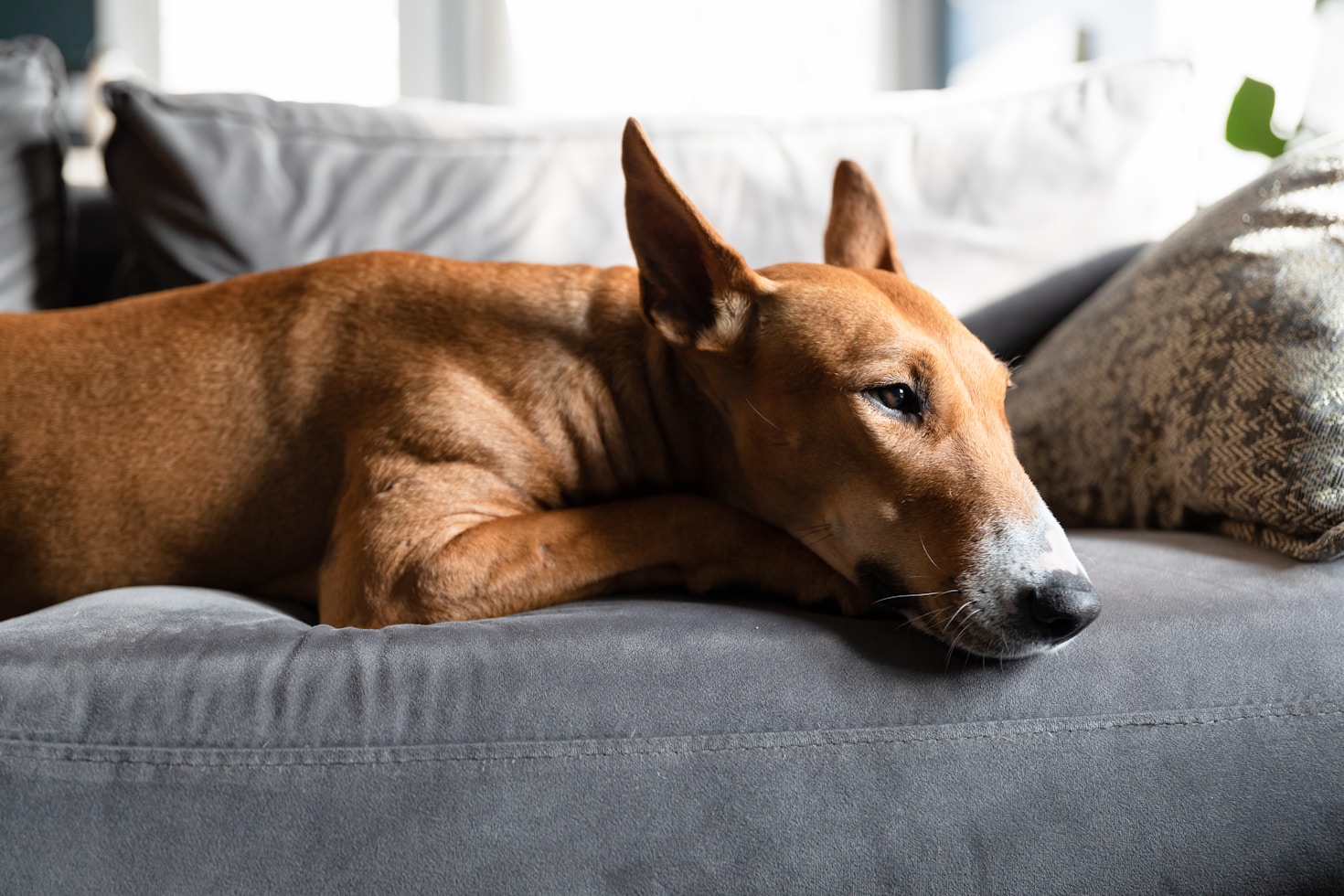
Calm at rest is the benchmark. Every session aims to stay below the threshold where this state is disrupted.
Phase 3: sub-threshold absence training
With departure cues neutralised, you begin working on absence duration. The structure is precise:
The departure–return cycle
Leave for a duration below your dog's threshold. Return before any anxiety signal appears. Mark the return with calm, low-key attention — no excited greeting, no "good dog, you were so brave". Neutral return. Wait 20–30 seconds, then leave again for another sub-threshold duration. Repeat 10–15 cycles per session. One session per day, five days per week.
Vary the duration unpredictably within each session. If your dog's threshold is 8 seconds, you might do: 4 seconds, 6 seconds, 3 seconds, 5 seconds, 7 seconds, 4 seconds. The unpredictability is deliberate — it prevents the dog from building a countdown anxiety that peaks as they approach their maximum known alone time.
Keep a simple log. Date, session duration range, any anxiety signals observed, threshold indicator (did you stay below it?). This log becomes your protocol record and your regression recovery map.
Reading the dog during sessions
Watch the camera feed continuously during every departure. You are looking for two things: absence of anxiety signals (good — the session is working) and the earliest possible indicator of any anxiety signal (the trigger to return immediately).
Sub-threshold success looks like: the dog watches the door briefly, then lies down, then shifts position, then closes their eyes. Or walks to a favourite spot and settles. The body language is loose. The breathing is normal. This is the dog's nervous system experiencing absence without a threat response — and this is the neurological repetition that builds genuine tolerance.
Phase 4: building duration incrementally
Once your dog is consistently calm at their starting threshold across three to five sessions, you can begin extending duration. The rate of increase is slow by design:
- Week 1–2 of absence training: increase by 5–10 seconds per session, only if the previous session showed consistent calm
- Week 3–4: increase by 15–30 seconds per session
- Week 5–6: increase by 1–2 minutes per session, reaching the 10–15 minute range
- Week 7–8: increase by 5–10 minutes per session, targeting the 40–90 minute range
These are approximate progressions — your dog's nervous system dictates the actual pace. If anxiety signals appear at a new duration, that duration was above threshold. Step back to the previous level, consolidate it across two to three sessions, and attempt the increment again.
The 40-minute mark is the critical milestone. Research measuring salivary cortisol shows that canine stress peaks at 30–40 minutes after departure. A dog who can remain below threshold at 40 minutes has cleared the most neurologically demanding stage of the protocol.
Once your dog reaches consistent calm at 40 minutes, the progression to 90 minutes — and eventually four hours — is typically much faster. The 40-minute cortisol peak is the hardest hurdle. After it, the cortisol curve begins to descend, and the dog's stress state becomes progressively less acute with longer absences.
Phase 5: real-world resilience
Duration alone is not the endpoint. A dog who can cope with a 90-minute absence in controlled training conditions may still become distressed in real-world departures that vary from the training context. The final phase introduces variability:
- Vary departure cues: leave via the back door sometimes. Use different shoes. Leave without the bag you usually take. The goal is for calm independence to be generalised — not cue-specific.
- Vary departure times: training at 9am every day creates an anticipatory response to 9am departures. Vary the time across the full range of your actual working schedule.
- Vary the environment: if the dog is always trained in one room, practise brief absences from different rooms. Introduce your dog to the absence pattern from the kitchen, not just the living room.
- Proof the 40-minute window: do not assume that passing the 40-minute threshold once means it is consolidated. Practise multiple sessions across the 30–50 minute range before moving beyond it.
Handling regressions
Regressions are not failures. They are data. A flooding event — an unavoidable absence that pushed beyond the dog's current threshold — does not erase progress. It resets the acute cortisol state and may require stepping back two to three session levels. It does not require starting over.
When a regression occurs:
- Do not attempt to push through or "test" the dog at the level that caused the regression
- Return to a duration you know is below threshold — usually 50–70% of the level where the regression occurred
- Run two to three consecutive successful sessions at this level before advancing
- Advance more slowly through the regressed range on the second pass
Some dogs regress after genuine life events: a move, a new baby, a change in schedule. These regressions are predictable. If a significant life change is planned, build in a consolidation phase before the change rather than attempting to maintain progress during it.
The five mistakes that reset progress
These are the errors that most commonly derail otherwise well-executed desensitisation protocols:
- Waiting for the dog to calm down before returning. If you return only after distress stops, you have taught the dog that distress is the mechanism that brings you back. Return immediately when any signal appears — the dog is not rewarded for the distress, and the flooding event is minimised.
- Excited greetings on return. Emotional reunions signal that absence is a significant event. Neutral re-entry — walk in, say nothing, settle into a normal activity — communicates that departure and return are unremarkable. This is counter-intuitive but neurologically important.
- Inconsistent sessions. Three sessions one week, none the next does not build neurological tolerance. The protocol requires daily or near-daily repetition for the amygdala's prediction patterns to genuinely shift.
- Advancing too fast. Owners who see progress are often tempted to jump ahead. This is the most common reason the protocol stalls at four to six weeks. Measured, slow progression outperforms optimistic leaps every time.
- Flooding during the protocol. Any unplanned absence that exceeds the dog's current threshold is a flooding event. Manage the dog's environment — dog-walkers, daycare, a friend's house — to prevent flooding while the protocol is in progress.
How long the protocol takes
For mild to moderate separation anxiety, most dogs reach four-hour independence within eight to twelve weeks of consistent, structured work. The timeline splits approximately as follows:
- Weeks 1–2: departure cue desensitisation + threshold identification
- Weeks 3–4: sub-threshold absence training, building from seconds to 5–10 minutes
- Weeks 5–6: building through the 10–40 minute range
- Weeks 7–8: clearing the 40-minute cortisol peak, building to 90 minutes
- Weeks 9–12: building to four hours, variability training, real-world proofing
Severe cases — dogs with a history of self-injury, dogs who have been anxious for several years, dogs who show extreme pre-departure stress — typically require three to six months. A certified separation anxiety trainer (CSAT) is advisable in these situations.
What this protocol does not do: provide quick results. What it does do: provide permanent results. A dog whose amygdala has been genuinely reconditioned — not suppressed with medication or distracted with enrichment — retains that conditioning. The work is front-loaded and requires precision. The outcome is durable.
To understand the cortisol timeline that drives the 40-minute threshold, see The 40-Minute Rule: Why Your Dog's Anxiety Peaks When You Leave. If you are not yet certain whether your dog has separation anxiety or is simply under-stimulated, see Dog Separation Anxiety vs Boredom: The Science-Backed Difference before beginning this protocol.
The full 30-day protocol, structured day by day.
PAXA Solo is a 42-page science-backed workbook that takes you through the complete systematic desensitisation protocol — from threshold identification on Day 1 to four-hour independence by Day 30. Every session is planned. Every decision point is covered. Built for owners who want to fix the problem with precision, not manage it indefinitely.
Start the protocol — £29 →Instant download · 42-page PDF · Science-backed protocol