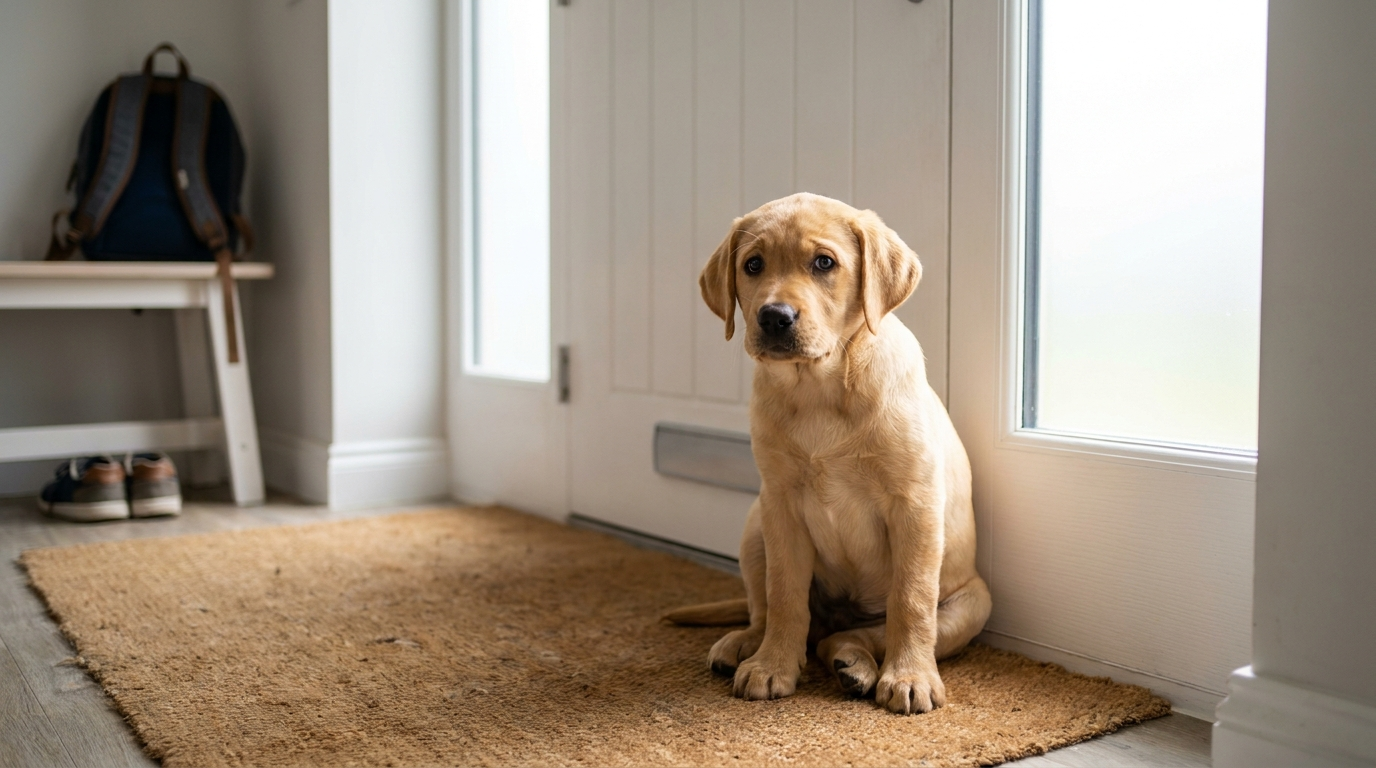
Your puppy cries the moment you close the door. The neighbours mention the barking. You try leaving a treat-stuffed Kong, turning the radio on, and starting with "short absences" — none of it helps. Here is why: the standard advice for puppy separation anxiety is designed for boredom, not for fear.
Puppy separation anxiety is a clinical stress response. The puppy's amygdala has associated your departure with danger, and every unmanaged absence reinforces that association at a neurological level. This is not a phase that puppies grow out of. Without structured intervention, the anxiety pattern typically intensifies as the dog matures.
This guide covers the five signs that distinguish true separation anxiety from normal puppy adjustment, why the most common training advice actively worsens the problem, and the exact protocol that genuinely resolves it — not by masking distress, but by rewiring the fear response at its source.
Why puppies are especially vulnerable to separation anxiety
Between three and twelve weeks, puppies go through a critical socialisation period during which the brain is particularly sensitive to new experiences. Neural associations formed during this window — including associations between departure cues and safety or danger — become disproportionately stable.
A puppy that experiences repeated departures above their anxiety threshold during this period does not adapt. They escalate. Each unmanaged absence reinforces the amygdala's prediction that being alone equals threat, and research published in Applied Animal Behaviour Science consistently shows that salivary cortisol spikes sharply within the first 30–40 minutes of separation — a physiological response, not a behavioural choice.
The post-pandemic cohort of UK puppies — purchased between 2020 and 2022 when owners were home constantly — is particularly affected. These dogs spent their entire socialisation window with humans present. The adjustment to even short absences now represents a profound change in their baseline expectation of the world.
Blue Cross UK estimates that a significant proportion of puppies develop some form of separation-related distress, with the risk elevated in breeds with high human attachment drive — Labradors, Cockapoos, Spaniels, and Golden Retrievers among them.
The puppy's cortisol response to departure is not behaviour to be corrected. It is physiology to be retrained — and physiology responds to systematic desensitisation, not to reassurance or avoidance.
The 5 signs of puppy separation anxiety (not just normal settling)
Not every puppy who whimpers when you leave has clinical separation anxiety. Some distress during initial alone-time training is normal and expected. The distinction matters enormously — because the treatment for normal adjustment is patience and graduated alone time, while the treatment for true separation anxiety is systematic desensitisation starting below the puppy's anxiety threshold.
These five markers are what clinicians and Association of Pet Dog Trainers (APDT) members use to distinguish clinical SA from normal behaviour:
Sign 01
Vocalising within minutes of departure
A puppy with true separation anxiety does not settle after a few minutes of crying. The vocalising — barking, howling, sustained whimpering — begins almost immediately after you leave and does not reduce over the course of the absence. This is a cortisol response, not attention-seeking behaviour. A normally adjusting puppy will typically reduce their vocalising within ten to fifteen minutes as they realise departure is temporary.
Sign 02
Refuses food and treats when alone
Leave a high-value treat — chicken, cheese, something irresistible — and check whether it has been touched on return. A puppy in genuine anxiety will not eat it. Elevated cortisol suppresses the digestive system and inhibits the reward pathway. The puppy is physiologically incapable of eating when distressed. A puppy who is merely adjusting to alone time will eat the treat. This single test has significant diagnostic value.
Sign 03
Exit-focused destructive behaviour
If your puppy chews the door frame, scratches the front door, attacks the baby gate, or destroys items near exits specifically — this is escape-seeking behaviour, not boredom. The puppy is attempting to follow you. Boredom produces scattered destruction across all available objects. Separation anxiety produces destruction at the point where you disappeared. The focus matters diagnostically.
Sign 04
Physiological stress markers
Drooling, panting disproportionate to temperature, pacing in a repetitive pattern, trembling, house soiling in a previously housetrained puppy, or self-injury from escape attempts — these are the signs of sympathetic nervous system activation. The body is in emergency mode. Dogs Trust lists these physiological signs as key clinical indicators distinguishing separation anxiety from boredom or standard settling behaviour.
Sign 05
Immediate, intense relief on return
The puppy's distress resolves the moment you appear — not after a few minutes of calm, but instantly. This contrast between panic during absence and total calm in your presence is the defining pattern of separation anxiety. The owner is the safety signal. When the safety signal is absent, the threat prediction activates. When it returns, the threat prediction resolves.
Why "just leave them, they'll get used to it" makes things worse
The most common advice for puppy separation anxiety in the UK is to simply leave the puppy for progressively longer periods and let them habituate. This approach is called flooding — full-intensity exposure to the fear trigger without the ability to escape.
For a puppy with true separation anxiety, flooding does not produce habituation. It produces one of two outcomes:
Learned helplessness. The puppy stops vocalising and appears to "settle." Owners interpret this as progress. The research tells a different story. Studies measuring cortisol in dogs who have stopped vocalising after repeated flooding show that salivary cortisol levels remain elevated — sometimes for hours. The dog has not recovered. It has entered a passive shutdown state where it has stopped attempting to signal distress. The anxiety is unchanged; only the expression of it has been suppressed.
Threshold sensitisation. Each flooding event where the puppy reaches panic state does not reduce the amygdala's threat prediction — it confirms it. Every unmanaged high-intensity absence is evidence, from the puppy's neurological perspective, that departure equals genuine danger. The threshold at which anxiety activates may lower over time, not raise. The dog becomes more sensitive, not less.
This is why owners who "just leave them" often find the problem worse at six months than it was at eight weeks. The flooding approach is not neutral. It actively compounds the problem it is meant to solve.
For additional context on how flooding differs from systematic desensitisation, see our guide to dog desensitisation training: a step-by-step guide for UK owners.
The PAXA Solo workbook contains the complete 30-day protocol for puppy and adult dog separation anxiety — including the exact threshold assessment method and departure cue desensitisation sequence.
Start the protocol — £29 →The correct approach: systematic desensitisation from day one
The evidence-based treatment for puppy separation anxiety is systematic desensitisation combined with counter-conditioning. This is the approach endorsed by the RSPCA, the PDSA, and the wider veterinary behavioural science community. It differs from standard puppy alone-time training in one critical respect: every session runs below the puppy's current anxiety threshold.
Step 1: Identify your puppy's actual threshold
Your puppy's threshold is the point at which any anxiety signal — panting, pacing, whimpering, refusal to engage with food — first appears during an absence. This might be five seconds. It might be thirty seconds. It might be three minutes. The number does not matter. The precision does.
To find it: leave your puppy, watch on a camera or phone, and note the exact moment any stress signal appears. Subtract five to ten seconds. That is your starting point for training sessions.
You are not training your puppy to tolerate anxiety. You are training them at durations so short that no anxiety occurs. This is the core principle of sub-threshold training, and it is what makes systematic desensitisation work where flooding fails.
Step 2: Desensitise departure cues before you leave
Most puppies with separation anxiety begin showing stress before the owner reaches the door. They have learned to read departure cues — keys picked up, shoes put on, jacket retrieved — as reliable predictors of abandonment. The amygdala starts its threat cascade before the owner has even left.
Before working on actual absences, spend one to two weeks systematically desensitising departure cues. Pick up your keys and put them down — no departure. Put on your shoes and sit back down. Touch the door handle and walk away. Repeat each cue dozens of times daily, always without actually leaving, until the puppy shows no anticipatory stress response to any of them.
This alone — departure cue work — produces measurable improvement in most puppies within ten to fourteen days of consistent daily sessions. The cortisol spike that peaks 30–40 minutes after departure cannot build if the amygdala never activates at the trigger cues in the first place.
Step 3: Build absences in measurable, sub-threshold increments
Once departure cues are desensitised, begin actual absences. Always start below your identified threshold. Build duration in small increments — seconds to minutes, not minutes to hours. Use a camera to observe remotely. Stop any session at the first sign of anxiety.
A sample first-week progression for a puppy with a two-minute threshold might look like:
- Day 1–2: Absences of 30–60 seconds, ten repetitions per session
- Day 3–4: Absences of 60–90 seconds, eight repetitions per session
- Day 5–7: Absences of 90–150 seconds, six repetitions per session
The progression is not linear. Some days your puppy will handle five minutes easily. Other days they will threshold at ninety seconds for no apparent reason. These fluctuations are normal. Step back on difficult days rather than pushing through. Pushing through is flooding. Stepping back is training.
Step 4: Manage real-world absences during the training period
This is the part most owners find hardest. While you are training, every absence that exceeds your puppy's current threshold is a setback. A single flooding event can undo a week of careful sub-threshold work.
During the training period, if you must leave for longer than your puppy's current threshold, use a trusted dog-sitter, neighbour, or doggy daycare — not because long absences are permanently off the table, but because the training period requires that the amygdala be not re-traumatised while the new neural pathway is being established.
The Dogs Trust guidance on dogs spending time alone aligns with this approach: build duration in controlled sessions, not through unmanaged life absences.
How long does puppy separation anxiety training take?
Honest answer: four to eight weeks for mild to moderate cases with consistent daily training. The primary variables are severity, consistency of training, and whether flooding events are successfully avoided during the process.
The duration of the problem is not a reliable predictor of treatment length. A puppy who has had separation anxiety for four months may respond faster than one who has had it for six weeks, if their nervous system is more resilient and their baseline threshold is higher.
What does predict treatment length is consistency. Daily sessions of ten to twenty minutes, run below threshold every time, compound quickly. Missed days, inconsistent application, and "testing" the dog with longer absences before the threshold has genuinely extended — these extend the timeline significantly.
For a detailed breakdown of week-by-week expectations, see our guide to how long it takes to fix dog separation anxiety.
What does not help — and why
Calming treats and supplements
Products containing L-theanine, ashwagandha, CBD, or valerian may reduce generalised anxiety in some dogs. They do not treat separation anxiety. Separation anxiety is a specific learned fear response triggered by a specific stimulus — owner departure. Generalised anxiolytics do not retrain the amygdala's prediction about that specific trigger. They may slightly reduce the physiological stress response, but they do not produce lasting behavioural change when used alone.
The same applies to DAP diffusers and calming collars. For a detailed explanation of why symptom management approaches fail, see our article on why calming treats don't fix dog separation anxiety.
Getting a second dog
True owner-specific separation anxiety — where the trigger is your absence, not isolation in general — will not be resolved by a canine companion. The puppy will remain distressed with another dog present, because the safety signal (you) is still absent. A second dog is an additional management responsibility on top of an unresolved problem.
Crates and confinement
A crate does not treat separation anxiety. A puppy in genuine distress is equally or more distressed in a crate — the confinement prevents escape-seeking behaviour but does not address the fear. Crate training can be valuable for other reasons, but it should be separated from SA treatment entirely.
Punishment and ignoring
Punishing a puppy for vocalising during absence — through sound deterrents, spray collars, or verbal correction on return — does not reduce anxiety. It adds an additional aversive stimulus on top of an already distressing state. Research from veterinary behaviourists consistently shows that punishment-based approaches to separation anxiety prolong treatment timelines and can produce secondary fear responses.
The puppy separation anxiety training checklist
If you are starting from scratch, this is the sequence that produces results:
- Establish a calm baseline. Ensure your puppy has sufficient aerobic exercise and decompression time before training sessions. A rested, physiologically calm puppy has a higher threshold and learns faster. Thirty minutes of aerobic activity reduces cortisol by up to 30%, raising the anxiety threshold before training begins.
- Identify the threshold. Use a camera, note the first anxiety signal, subtract five to ten seconds. This is your training starting point.
- Run departure cue desensitisation daily for one to two weeks. Keys, shoes, jacket, door handle — each cue repeated until completely neutral.
- Begin sub-threshold absence sessions. Short. Below threshold. Repeated. Observed via camera. End at the first sign of anxiety, not after.
- Manage all real-world absences during training. No flooding events. Dog-sitter, neighbour, daycare — whatever it takes to avoid setting your puppy above threshold while the new neural pathway establishes.
- Build incrementally and track progress. Keep a simple log: date, session duration, puppy state at end. Patterns become visible within a week.
- Expect and plan for regressions. A single flooding event is not failure. It is data. Step the threshold back, not all the way to zero, and continue.
This is the structure behind the PAXA Solo 30-day protocol. The protocol maps each of these steps into a daily sequence with specific thresholds, regression protocols, and decision points — removing the guesswork from what is, in practice, a highly individual process.
Puppy separation anxiety: frequently asked questions
Is puppy separation anxiety normal?
Some distress when first left alone is normal in young puppies — they have evolved to signal for their mother. However, clinical separation anxiety — a full stress response with refusal to eat, exit-focused destruction, and sustained vocalising — is not something puppies simply grow out of. Without structured intervention, the anxiety pattern typically intensifies as the amygdala's threat prediction becomes more established with each unmanaged absence.
How long does puppy separation anxiety last?
Without intervention, there is no predictable timeline — and the pattern often worsens with age. With a systematic desensitisation protocol applied consistently, most puppies with mild to moderate separation anxiety show measurable improvement within four to eight weeks. Severity, consistency, and the absence of flooding events during training are the primary variables.
How long can I leave my puppy alone?
General UK guidance from Purina UK and the PDSA recommends no more than two hours for puppies under six months. For a puppy with separation anxiety, the relevant limit is their anxiety threshold — not their age. Training sessions should always remain below this threshold, even if it is as short as 30 seconds.
Will getting a second dog help?
Rarely. True owner-specific separation anxiety is triggered by the owner's absence, not isolation in general. A canine companion does not resolve the fear response to you leaving. A second dog is an additional management challenge on top of an unresolved behavioural problem.
Should I crate my puppy for separation anxiety?
A crate does not treat separation anxiety. A puppy in genuine distress will be equally or more distressed in a crate — confinement prevents escape-seeking behaviour without addressing the underlying fear. Crate training has other benefits but should be entirely separate from separation anxiety treatment.
Can puppy separation anxiety be fixed permanently?
Yes. Separation anxiety is a learned fear response — and because it is learned, it can be unlearned. The brain's neuroplasticity allows the amygdala's threat prediction to be genuinely rewired through systematic desensitisation and counter-conditioning. The goal is a puppy who is calm, resting, and capable of eating during the owner's absence — not one who has simply learned to suppress distress signals.
How do I know if it's separation anxiety or just normal puppy crying?
The clearest single diagnostic test: leave a high-value treat and check on return whether it has been touched. A puppy in genuine separation anxiety will not eat it — cortisol suppresses the digestive system. A puppy who is simply adjusting to alone time will eat it. For a full diagnostic framework, see our guide to separation anxiety versus boredom in dogs.
Key takeaways
- Puppy separation anxiety is a neurological stress response, not a behavioural phase. Without structured intervention, it typically intensifies rather than resolves.
- The five clinical signs — immediate vocalising, food refusal when alone, exit-focused destruction, physiological stress markers, and intense relief on return — distinguish true SA from normal puppy adjustment.
- The "just leave them" approach is flooding, not training. It produces learned helplessness or threshold sensitisation — neither of which is recovery.
- Systematic desensitisation begins below the puppy's current anxiety threshold. Every session below threshold builds the new neural pathway. Every session above it reinforces the old one.
- Departure cue desensitisation is the first phase. The anxiety often starts before you leave — and this is where the protocol starts too.
- Consistent daily sessions of ten to twenty minutes produce results in four to eight weeks for most mild to moderate cases.
- All real-world absences must be managed during training. A single flooding event can set the threshold back by a week.
For a deeper understanding of the cortisol timeline in separated puppies, see The 40-Minute Rule: Why Your Dog's Anxiety Peaks When You Leave. If you are unsure whether your puppy has true separation anxiety or is simply under-stimulated, the diagnostic framework in Dog Separation Anxiety vs Boredom: The Science-Backed Difference will clarify the distinction. For the complete step-by-step desensitisation method, see Dog Desensitisation Training: A Step-by-Step Guide for UK Owners.
Your puppy needs a protocol, not reassurance.
PAXA Solo is a 42-page science-backed workbook that maps the complete systematic desensitisation and counter-conditioning protocol into 30 daily sessions — with threshold identification, departure cue work, regression protocols, and week-by-week milestones. Built specifically for UK owners who want to fix the problem, not manage it indefinitely.
Start the protocol — £29 →Instant download · 42-page PDF · Science-backed protocol · 30-day structure