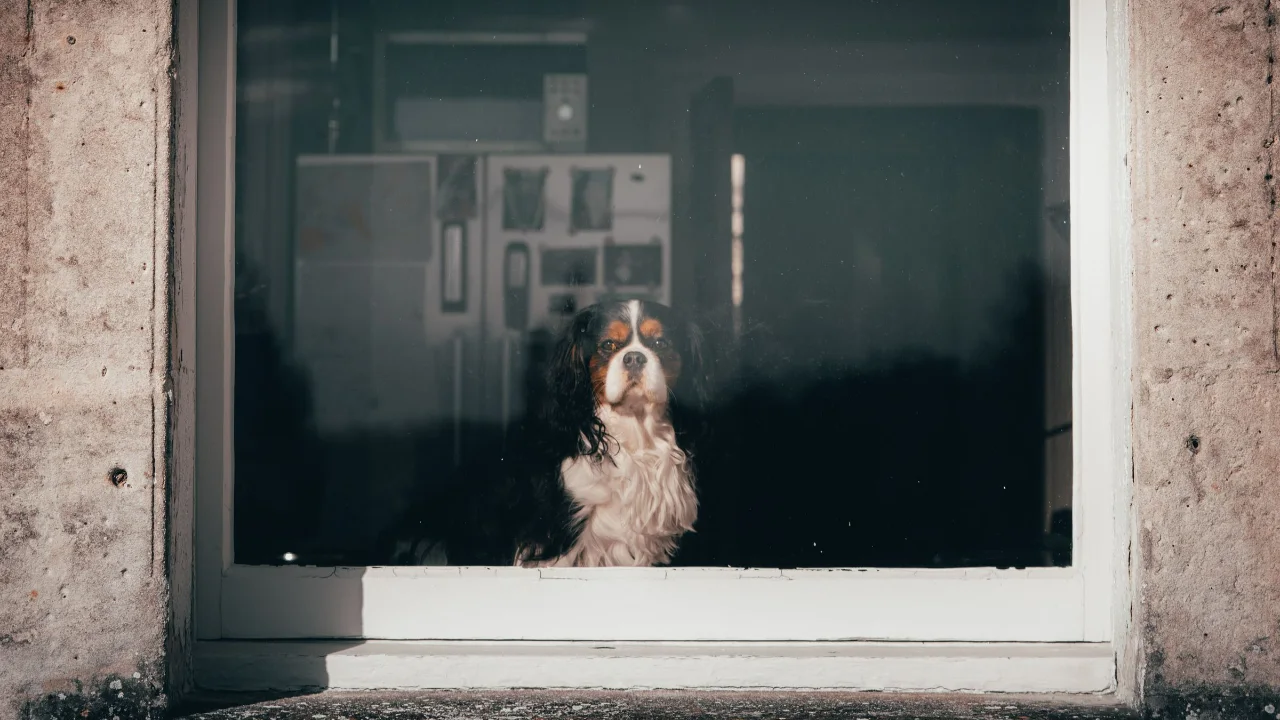
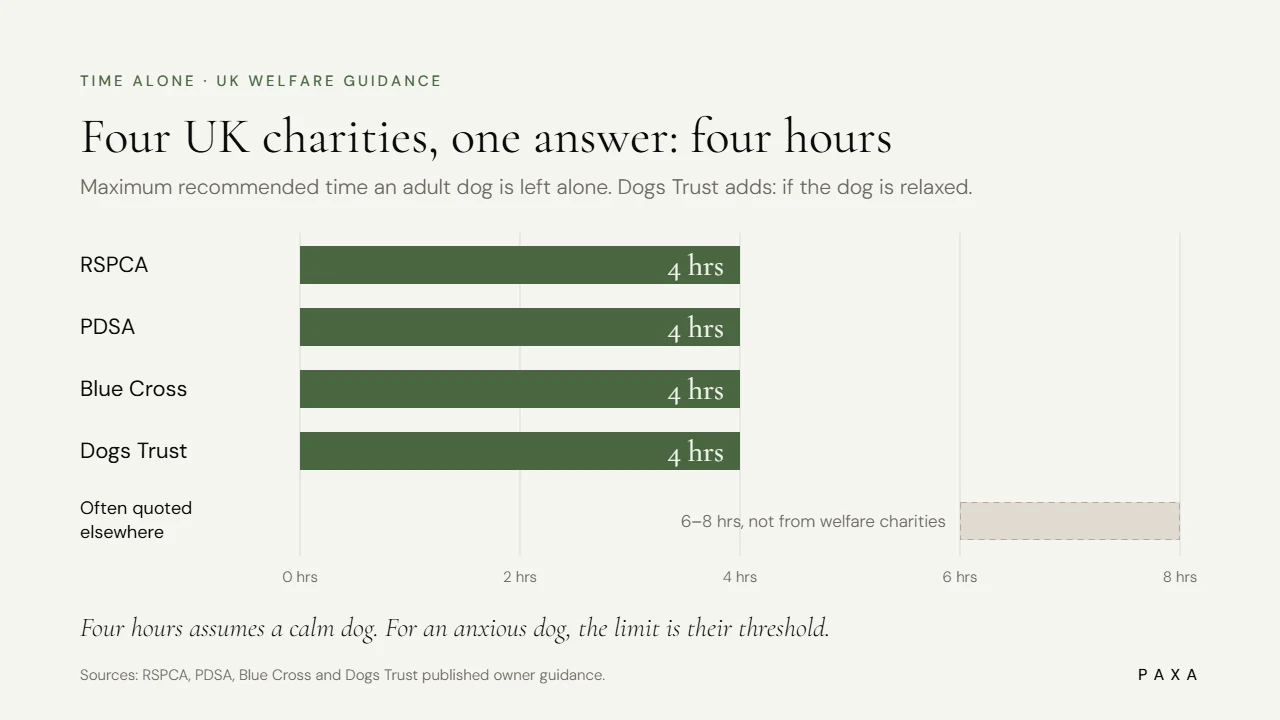
Ask the RSPCA, PDSA, Blue Cross or Dogs Trust how long a dog can be left alone and you get the same answer: four hours at most. What is easy to miss is the condition attached to it. Dogs Trust puts it plainly. Four hours is the maximum if your dog is relaxed.
For a dog who settles when you leave, four hours is a sensible ceiling. For a dog who paces, barks or panics, the limit is not four hours. It is however long they can stay calm, and for some dogs that is less than a minute. Leaving them for longer does not toughen them up. It teaches them that being alone is something to fear.
This guide covers what the charities and the law actually say, how the answer changes with age, how to find out what your own dog can cope with, and what to do when your working day is longer than your dog can manage.
Quick answer: UK animal charities advise leaving an adult dog alone for no more than four hours at a time, and puppies for much less. There is no fixed legal limit, but the Animal Welfare Act 2006 requires you to meet your dog's needs. The four-hour figure assumes a dog who is calm alone. If your dog shows signs of separation anxiety, their safe limit is their threshold, which can be built up to four calm hours with consistent training, typically in around 30 days.
What UK charities say
The guidance from the major UK animal welfare organisations is unusually consistent:
- RSPCA: the time depends on the individual dog, but they advise no longer than four hours.
- PDSA: four hours is the longest a dog should routinely be left, and every dog is different.
- Blue Cross: never more than four hours at a time.
- Dogs Trust: a maximum of four hours, if the dog is relaxed.
You will find pet food and insurance sites quoting six or eight hours. Those figures do not come from the welfare charities, and they rarely mention the dog's emotional state at all. A dog can hold their bladder for six hours and still spend most of that time distressed.
What the law says
There is no set number of hours in UK law. What the law does set is a duty of care. Under section 9 of the Animal Welfare Act 2006, owners in England and Wales must take reasonable steps to meet their animal's needs, including a suitable environment, the ability to behave normally, and protection from suffering. Scotland and Northern Ireland have equivalent laws.
In practice, a single long day is unlikely to be a legal matter. A pattern of leaving a dog alone for long periods, distressed and without toilet breaks, can be. The charities' four-hour guidance is the clearest benchmark of what meeting those needs looks like.
How long can you leave a dog alone, by age?
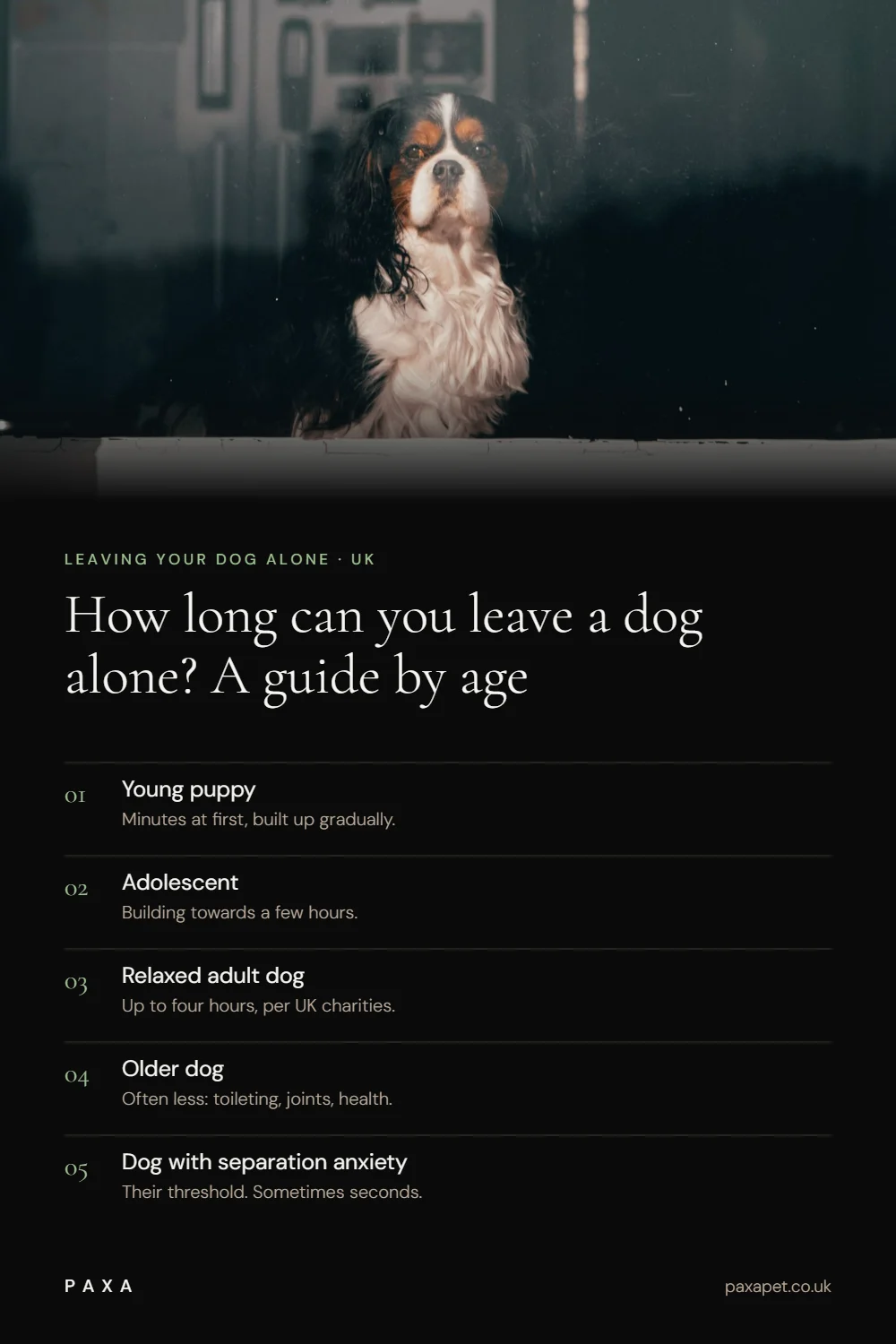
Age changes the answer, mostly because of toileting, energy and health. Use this as a starting point, then adjust for your own dog.
| Dog | Realistic time alone | What limits it |
|---|---|---|
| Young puppy | Minutes at first, built up gradually | Bladder control, and learning that alone is safe |
| Adolescent | Building towards a few hours | Energy, chewing, still-forming habits |
| Relaxed adult | Up to four hours | Charity guidance: company, toilet, stimulation |
| Older dog | Often less than four hours | Toileting, joint stiffness, health conditions |
| Dog with separation anxiety | Their threshold, sometimes seconds | Fear, not boredom or bladder |
Puppies. A puppy's first lessons about being alone shape how they feel about it for years. Start with very short absences while they are calm or sleepy, and come back before they become upset. Some unsettled behaviour in the first weeks in a new home is normal. If it persists or escalates, read our guide to puppy separation anxiety.
Adults. A healthy adult dog who is comfortable alone can usually manage up to four hours, ideally after a walk and with somewhere comfortable to rest. Many dogs simply sleep.
Older dogs. Senior dogs often need to toilet more often, and some become more anxious alone as they age. A dog who was fine for four hours at five years old may not be at twelve. New distress in an older dog is worth a vet check, because pain and cognitive decline can both look like separation anxiety.
Not sure what your dog can cope with? Start with two days.
Days 1 and 2 of the PAXA Solo protocol are free. They show you how to find your dog's real threshold, the number of seconds or minutes they can stay calm, before you plan anything else.
Get Days 1 & 2 free →The four-hour rule assumes a calm dog
The charity guidance answers the question "how long before a dog's basic needs go unmet?" It does not answer "how long before this particular dog becomes frightened?" For most dogs those two numbers are close. For a dog with separation anxiety, they are hours apart.
Separation anxiety is a learned fear response. Your dog's amygdala, the brain's threat detector, has learned to predict that being alone means danger. Stress hormones such as cortisol rise after you leave and tend to peak around 30 to 40 minutes into an absence, which is why a dog can look fine when you walk out and be in a very different state by the time you are on the train.
Every absence that goes beyond your dog's threshold adds fresh evidence that being alone is dangerous. That is why the common advice to "just leave them, they will get used to it" so often backfires. We explain the mechanism in five things that make separation anxiety worse.
How to find out how long your dog can really be left
You cannot judge this from the door, and you cannot judge it from what you find when you come home. A quiet house on your return can mean your dog slept, or that they spent an hour pacing and then gave up. The only reliable way is to watch.
- Set up a camera. A phone on a video call, a laptop or a pet camera, pointed at where your dog usually waits.
- Leave as you normally would. Same routine, same cues, same door.
- Watch the first 30 minutes. Most distress shows early. Note the moment your dog's behaviour changes.
- Come back before it escalates. You are gathering information, not testing endurance.
A dog who is coping will usually potter, sniff, then lie down and settle. Signs your dog is not coping include:
- Pacing, panting or circling that does not settle
- Barking, whining or howling, especially at the door
- Scratching or chewing at doors, windows or crates
- Toileting indoors when they are otherwise house-trained
- Drooling, trembling, or refusing food left for them
Some of these overlap with boredom, and some dogs are simply clingy without being anxious. If you are not sure which you are seeing, our guides to separation anxiety vs boredom and velcro dog or separation anxiety help you tell the difference.
PAXA Solo is a 30-day systematic desensitisation and counter-conditioning protocol that builds your dog's time alone from their current threshold towards four calm hours, one small step at a time.
Start the protocol — £29 →If you work full time
An eight-hour working day plus a commute is twice the charity guidance, even for a relaxed dog. That does not mean full-time workers cannot have dogs. It means the day needs breaking up. The common UK options:
- A dog walker for a midday visit, which splits the day into two shorter absences.
- Doggy daycare for some or all working days. Suits sociable dogs; some anxious dogs find it overwhelming.
- A friend, neighbour or family member who can drop in or have your dog for the day.
- Hybrid working, with office days arranged around cover.
Costs vary widely by area. We compare them with the cost of training in our UK guide to what separation anxiety costs.
If your dog has separation anxiety, cover matters even more while you train. Each absence beyond their threshold works against the training, so the aim during those weeks is to avoid them where you possibly can. That is temporary. The goal of training is a dog who no longer needs it.
How to build up the time your dog can be left
Whether you are starting with a new puppy or a dog who struggles, the method is the same: short absences your dog can handle calmly, repeated and gradually extended. This is systematic desensitisation, and it is the approach behind every effective treatment for separation anxiety.
- Find the threshold. Use the camera method above to find the point where your dog begins to show stress.
- Work below it. If your dog copes for 60 seconds, start at 30. The absence should end while your dog is still relaxed.
- Build in small, uneven steps. Thirty seconds, a minute, 45 seconds, two minutes. Varying the length stops your dog anticipating the hard part.
- Defuse departure cues. Pick up keys or put on shoes without leaving, until those cues stop predicting an absence.
- Train daily. Short sessions most days do far more than long sessions at the weekend.
Our step-by-step desensitisation guide covers each stage in detail, and how long separation anxiety lasts sets out a realistic week-by-week timeline. Most dogs with mild to moderate separation anxiety reach four calm hours in around 30 days of consistent training; severe cases often take six to eight weeks. If your dog is hurting themselves or cannot cope with even a few seconds alone, speak to your vet first.
Find your dog's real number this week.
The first two days of the PAXA protocol walk you through finding your dog's threshold and running the first sub-threshold sessions. Free to download, and useful whether or not you go further.
Get the free 2-day start →Leaving a dog alone: frequently asked questions
How long can you legally leave a dog alone in the UK?
There is no fixed legal time limit. The Animal Welfare Act 2006 requires owners to meet their dog's needs, including a suitable environment and protection from suffering. UK charities including the RSPCA, PDSA, Blue Cross and Dogs Trust advise no more than four hours at a time for an adult dog.
Can I leave my dog alone for 8 hours while I am at work?
UK charities advise against it. Eight hours is twice the recommended maximum, even for a dog who is relaxed alone. Most full-time workers break the day up with a dog walker, daycare, or a friend or family member who can visit or look after the dog.
How long can a puppy be left alone?
Much less than an adult dog. Start with a few minutes while your puppy is calm or sleepy, return before they become upset, and build up gradually. Puppies also need frequent toilet breaks. Distress that persists or gets worse after the first weeks in a new home may be puppy separation anxiety.
Is it OK to leave a dog alone overnight?
It is not recommended. A night away is far beyond the four-hour guidance, and your dog will need toileting, food and company. Arrange a sitter, a trusted friend or family member, or a boarding kennel instead.
How do I know if my dog is OK when I leave?
Film them. Set up a phone or pet camera and watch the first 30 minutes of a normal absence. A dog who is coping will usually settle and rest. Pacing, barking, howling, scratching at doors or toileting indoors are signs your dog is not coping and that their safe limit is shorter than the time you were away.
How do I build up the time my dog can be left alone?
Use systematic desensitisation: find the point where your dog starts to become anxious, practise absences shorter than that, and extend them in small, uneven steps with daily sessions. Most dogs with mild to moderate separation anxiety reach four calm hours in around 30 days of consistent training.
Key takeaways
- Four hours is the UK benchmark. The RSPCA, PDSA, Blue Cross and Dogs Trust all advise no more than four hours alone for an adult dog.
- There is no legal number, but the Animal Welfare Act 2006 requires you to meet your dog's needs.
- Puppies and older dogs need less. Build puppies up from minutes; review older dogs as their needs change.
- Four hours assumes a calm dog. For a dog with separation anxiety, the real limit is their threshold.
- The limit can be moved. Sub-threshold training builds most dogs towards four calm hours in around 30 days.
To go further: start with how to stop dog separation anxiety for the overview, or see dog independence training for building calm alone time from the start. If your dog came from a shelter, separation anxiety in rescue dogs covers the extra steps that apply to them.
Not ready for 30 days? Start with two.
Days 1 and 2 of the PAXA Solo protocol are free to download. See how the method works with your own dog before you decide on the full programme.
Get Days 1 & 2 free →Four hours is the guideline. This is how your dog gets there.
PAXA Solo is a 42-page science-backed workbook that maps the complete systematic desensitisation and counter-conditioning protocol into 30 daily sessions: threshold identification, departure cue work, regression protocols and week-by-week milestones, building from your dog's current limit towards four calm hours alone.
Start the protocol — £29 →Instant download · 42-page PDF · One-time purchase · No subscription