In the trial that led to Reconcile, the separation anxiety medication many UK vets prescribe, 72% of dogs on the drug improved within eight weeks. So did 50% of the dogs on a placebo. The difference was real, but it was not the whole story: every dog in that trial, on the drug or not, was following a behaviour plan.
If your vet has mentioned medication, or you are wondering whether your dog needs it, you are probably asking the same few questions. What can a UK vet actually prescribe? Does it sedate the dog? How long does it take to work, what does it cost, and will your dog be on it forever? This guide answers each one with the evidence, sources linked so you can check them.
The short version: medication is a legitimate, sometimes essential part of treating separation anxiety. It is not a replacement for the training that changes how your dog feels about being alone.
Quick answer: two medicines are licensed in the UK for separation-related problems in dogs, Reconcile (fluoxetine) and Clomicalm (clomipramine). Both are prescription-only and both are licensed as an aid to behaviour modification, not on their own. Vets may also prescribe drugs such as trazodone off-licence for specific departures. Daily medication commonly takes four to six weeks to reach full effect. In the trials, it made training work faster. It did not replace it.
What medication can and cannot do
Separation anxiety is a learned fear response. Your dog's amygdala, the brain's threat detector, has learned to predict that your departure means danger, and it fires the stress response before you have even reached the door. Stress hormones such as cortisol peak around 30 to 40 minutes into an absence, which is why so much of the distress happens after you have gone.
Behavioural medication lowers the baseline level of that anxiety. For a dog whose panic is so intense that they cannot settle for even a few seconds alone, that matters: a brain in full panic cannot learn. Medication can bring the dog down far enough that desensitisation training, short, calm absences that build up gradually, can start to do its job.
What medication does not do is teach the brain a new prediction. The learned link between your departure and danger is changed by new experience: many calm repetitions of being alone and nothing bad happening. That is why both UK-licensed medicines carry the same wording on their licence. They are an aid to treatment alongside behaviour modification.
Licensed separation anxiety medication in the UK
UK vets follow a rule called the prescribing cascade: where a veterinary medicine is licensed for a condition, they should normally consider it first. For separation anxiety, there are two.
Licensed 01
Reconcile (fluoxetine)
Daily chewable tablet · POM-VAn SSRI, the same drug class as the human medicine Prozac, made as a flavoured chewable tablet for dogs. It is licensed in the UK as an aid in the treatment of separation-related disorders, alongside a behaviour modification plan. In the placebo-controlled trial by Simpson and colleagues, 72% of dogs on fluoxetine plus behaviour management improved over eight weeks, against 50% on placebo plus the same behaviour management. The most commonly reported side effects in its label are reduced appetite, lethargy, shaking and vomiting. It is not suitable for dogs with a history of seizures.
Licensed 02
Clomicalm (clomipramine)
Twice-daily tablet · POM-VA tricyclic antidepressant. Its UK product licence covers use as an aid in treating separation-related disorders shown by destruction and toileting indoors, in combination with behavioural modification. In a randomised trial of 95 dogs, dogs on the standard dose with behavioural therapy were rated improved at least three times faster than dogs on placebo with the same therapy. Vomiting, lethargy and appetite changes are the most commonly reported side effects.
Notice the pattern. In both trials, the placebo dogs received the same behaviour plan, and many of them improved too. The medication sped improvement up and helped more dogs get there. The plan was doing work in both groups.
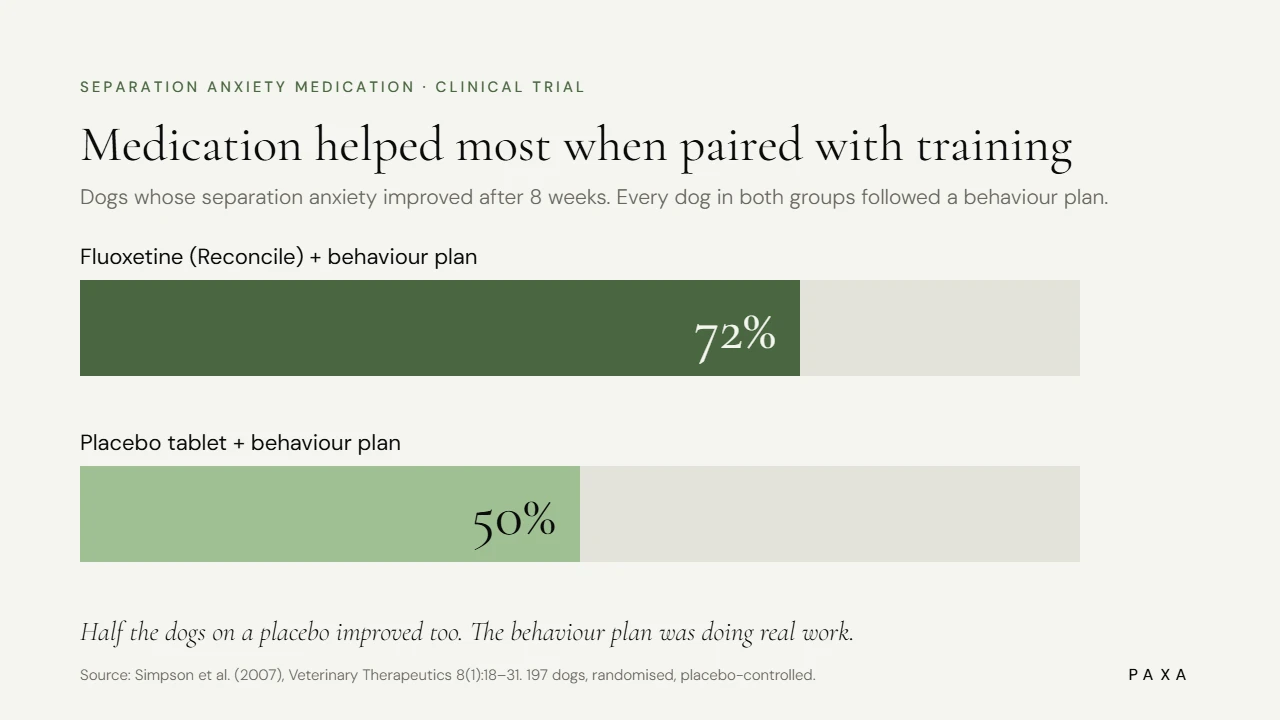
An independent 2022 evidence review in Veterinary Evidence rated the support for fluoxetine in canine anxiety as moderate, and noted that the trials behind it recommend behavioural and environmental changes alongside the drug, not instead of them.
Not ready for 30 days? Start with two.
Days 1 and 2 of the PAXA Solo protocol are free to download. See how the method works with your own dog, with or without medication, before you decide on the full programme.
Get Days 1 & 2 free →Off-licence medication your vet may consider
Under the cascade, a vet can prescribe a medicine that is not licensed for separation anxiety when the licensed options are unsuitable or not enough on their own. These are the ones you are most likely to hear about.
| Medicine | How it is used | Licensed for separation anxiety? |
|---|---|---|
| Fluoxetine (Reconcile) | Daily, builds up over weeks | Yes |
| Clomipramine (Clomicalm) | Daily, builds up over weeks | Yes |
| Trazodone | Before a departure or trigger, sometimes daily, often added to a daily medicine | No, prescribed off-licence |
| Gabapentin | Before a specific stressful event | No, prescribed off-licence |
| Sileo, Pexion | Licensed for noise fear, such as fireworks | No |
Trazodone is the most common addition. A study in the Journal of the American Veterinary Medical Association found it was well tolerated as an add-on to daily medication in dogs with anxiety-related problems, and owners rated it as helpful. Because it acts within hours, a vet may use it for days when an absence cannot be avoided.
One rule applies to all of them: never give your dog a human medicine, including leftover prescriptions. Doses for dogs differ, some human formulations contain ingredients that are toxic to dogs, and some combinations are dangerous. If your dog takes any supplement, including calming chews with tryptophan, tell your vet before starting medication.
Does my dog need medication?
Many dogs with separation anxiety improve with training alone. Dogs Trust's guidance is that, in most cases, a training programme should resolve the problem, and that any decision on medication should be made between your vet and a behaviourist. Medication is more likely to be part of the plan when:
- The panic is severe. Your dog cannot cope with even a few seconds alone, or with seeing you pick up keys or a coat.
- Your dog is hurting themselves. Broken teeth or claws, damaged doors or crates, or escape attempts are a reason to see your vet now.
- Training has stalled. You have followed a structured plan carefully for several weeks and the threshold will not move. Our guide to why separation anxiety can get worse covers the common reasons first.
- There is a wider anxiety picture. Fear of noises, visitors or new places alongside the separation problem.
- Absences cannot yet be avoided. Work patterns mean your dog is left beyond their threshold while training is under way.
Before any of this, your vet will check for a medical cause. Pain, urinary problems, gut problems and cognitive decline in older dogs can all look like separation anxiety. So can boredom or under-exercise, which is a different problem with a different fix; see separation anxiety vs boredom if you are not yet sure which you are dealing with.
What happens at the vet appointment
Expect a full clinical examination and a detailed history: when the problem started, what your dog does when alone, and what you have tried. A short video of your dog alone, recorded on a phone or pet camera, is one of the most useful things you can bring. If medication is appropriate, your vet will choose a drug and dose based on your dog's weight, age and health, and may run blood tests first, particularly for older dogs.
Many vets will also refer you to a behaviourist. In the UK, the Animal Behaviour and Training Council keeps a register of qualified clinical animal behaviourists and trainers. Pet insurers that cover behavioural treatment usually require a vet referral, so start with your vet if you plan to claim.
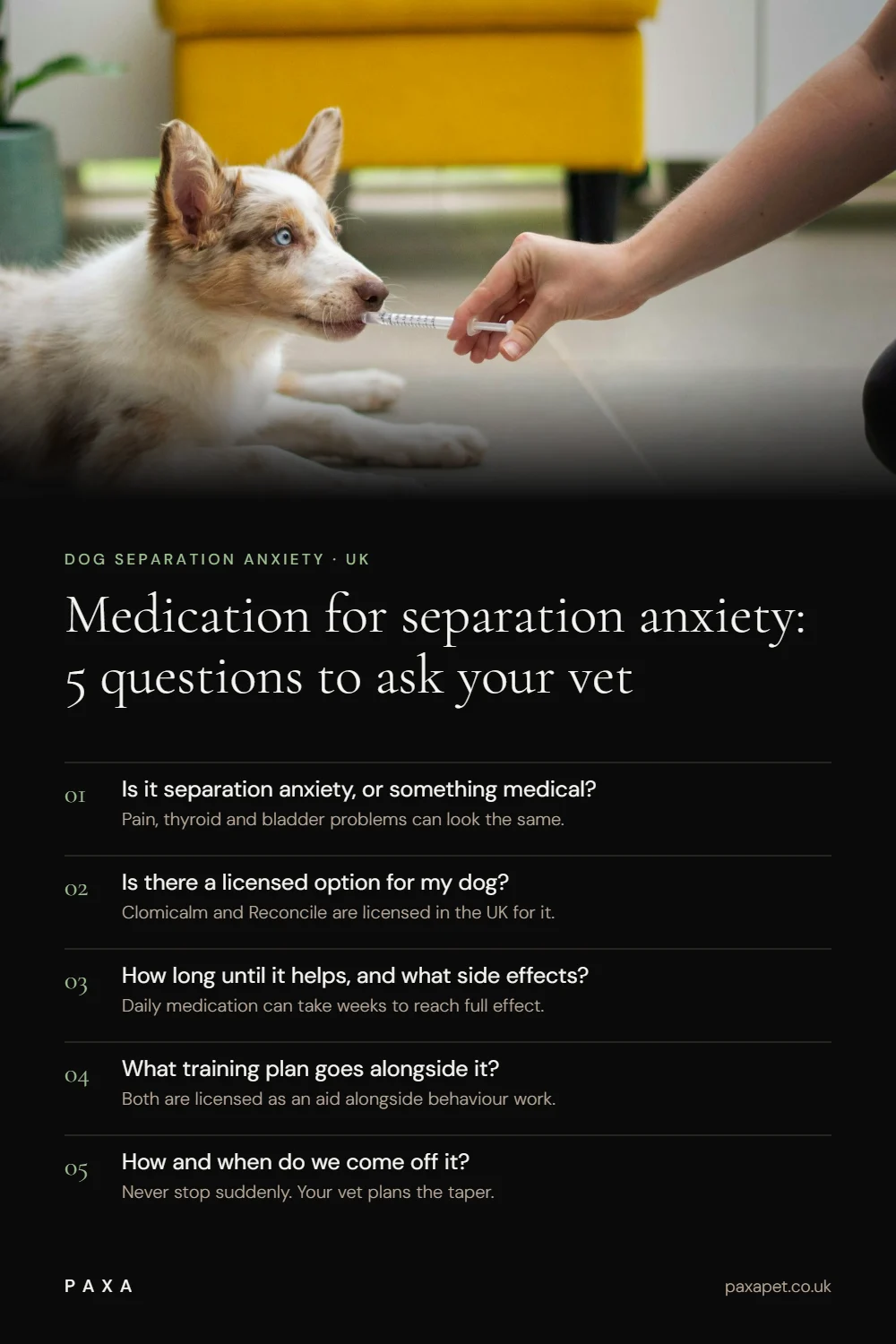
Ask your vet the five questions in the graphic above. The fourth matters most: if you leave with a prescription and no training plan, you have the aid without the treatment.
How long until it works, and how long does it last?
Daily medications such as fluoxetine and clomipramine build up gradually. Some dogs show a change within the first couple of weeks, but full effect commonly takes four to six weeks, and the main trials measured their results at eight weeks. Do not judge the medication on the first few days, and keep training throughout.
Most dogs do not need medication for life. Once training has changed how your dog responds to being alone and progress has been stable for a while, often several months, vets usually reduce the dose step by step. Never stop a daily behavioural medication suddenly. Your vet will plan the reduction, and keeping the training going during it protects the progress you have made. For honest expectations on the training side, see how long it takes to fix dog separation anxiety.
PAXA Solo is the training half of the plan: a 30-day systematic desensitisation and counter-conditioning protocol you follow at home, alongside your vet's advice.
Start the protocol — £29 →What separation anxiety medication costs in the UK
Prices vary by practice, by the size of your dog and by the drug, but as a guide:
- Consultation: roughly £40 to £80, more for a longer behavioural appointment.
- Medication: roughly £20 to £40 a month for a daily drug, more for large dogs.
- Repeat checks and prescriptions: your vet needs to see your dog regularly to keep prescribing, and written prescriptions usually carry a fee.
You are entitled to ask your vet for a written prescription and buy the medicine from an online veterinary pharmacy, which is often cheaper for long-term use. We compare medication with every other route, from behaviourists to self-guided plans, in our UK guide to what it costs to fix separation anxiety.
Calming tablets are not medication
Pet shops and supermarkets sell calming tablets, chews and diffusers next to the flea treatments, which makes them easy to confuse with medicine. They are supplements. They are not licensed to treat anything, and the evidence behind their usual ingredients, such as L-theanine, alpha-casozepine and tryptophan, is thin.
"There is no scientific evidence that any over the counter or non-prescription products work." — Dogs Trust
We explain why a generalised calming product cannot change a fear that is specific to your departure in why calming treats don't fix dog separation anxiety. If your dog's anxiety is serious enough that you are considering a product, it is serious enough for a vet appointment.
Medication plus a plan: how the two fit together
The way to think about it is a ramp. Medication lowers the slope so your dog can climb. The training is the climb. In practice, a combined plan looks like this:
- Vet first. Rule out medical causes, discuss whether medication suits your dog, and agree a review date.
- Find the threshold. The point, measured in seconds or in departure cues such as keys and shoes, where your dog starts to become anxious.
- Train below it. Short absences and departure cues your dog can handle calmly, built up in small steps, every day.
- Avoid absences beyond the threshold. A sitter, daycare or a friend covers the gaps, so each frightening absence does not undo the training.
- Review with your vet. Track progress so your vet can judge the dose and, later, the reduction.
That structure is the same whether or not medication is involved, and it is the method behind every effective treatment route. Our full guide to dog separation anxiety treatment in the UK explains each step, and can separation anxiety be cured? covers how lasting the change can be.
Talking to your vet this week? Start the training today.
Medication takes weeks to build up. The training can start now. Download the first two days of the PAXA protocol free and use them to find your dog's threshold, which is useful information to take to your vet appointment.
Get the free 2-day start →Dog separation anxiety medication: frequently asked questions
What medication do UK vets prescribe for dog separation anxiety?
Two medicines are licensed in the UK for separation-related problems in dogs: Reconcile (fluoxetine) and Clomicalm (clomipramine). Both are prescription-only and both are licensed as an aid alongside behaviour modification. Vets may also prescribe medicines such as trazodone or gabapentin off-licence under the veterinary cascade, usually given before a departure.
Can I buy separation anxiety medication for my dog without a prescription?
No. Reconcile, Clomicalm and the off-licence options are prescription-only veterinary medicines (POM-V). Your vet must examine your dog first. Calming tablets sold without a prescription are supplements, not medication, and Dogs Trust states there is no scientific evidence that over-the-counter products work.
How long does separation anxiety medication take to work in dogs?
Daily medications such as fluoxetine and clomipramine build up gradually. Some dogs show change in the first few weeks, but full effect commonly takes four to six weeks, and trials measured results at eight weeks. Situational medicines such as trazodone act within hours of a dose.
Will my dog need to stay on medication for life?
Usually not. Most vets aim to reduce medication gradually once training has changed the dog's response to being alone, often after several months of stable progress. Never stop a daily medication suddenly. Your vet will plan a slow reduction.
Does medication alone fix separation anxiety?
The evidence does not support it. In the main trials of fluoxetine and clomipramine, every dog, including those on placebo, followed a behaviour plan. Half the placebo dogs improved on the plan alone. Medication lowers anxiety enough for training to work. The training changes how the dog feels about being alone.
How much does dog anxiety medication cost in the UK?
Budget roughly £40 to £80 for the consultation and £20 to £40 a month for the medication, plus repeat check-ups and prescription fees. Prices vary by practice, dog size and drug. Many vets will provide a written prescription so you can buy from an online pharmacy.
Key takeaways
- Two licensed options in the UK. Reconcile (fluoxetine) and Clomicalm (clomipramine), both prescription-only.
- Both are licensed as an aid. The trials paired every dog with a behaviour plan, and half the placebo dogs improved on the plan alone.
- Expect weeks, not days. Daily medication commonly takes four to six weeks to reach full effect.
- Never stop suddenly, never use human medicine. Your vet manages the dose and the reduction.
- The training changes the fear. Desensitisation below threshold is the part that lasts after the medication stops.
To go further: start with how to stop dog separation anxiety for the overview, or, if your dog came from a shelter, separation anxiety in rescue dogs covers the extra steps that apply to them.
Not ready for 30 days? Start with two.
Days 1 and 2 of the PAXA Solo protocol are free to download. See how the method works with your own dog before you decide on the full programme.
Get Days 1 & 2 free →Medication lowers the slope. This is the climb.
PAXA Solo is a 42-page science-backed workbook that maps the complete systematic desensitisation and counter-conditioning protocol into 30 daily sessions: threshold identification, departure cue work, regression protocols and week-by-week milestones. It works on its own or alongside medication your vet prescribes.
Start the protocol — £29 →Instant download · 42-page PDF · One-time purchase · No subscription