Your dog doesn't need
to calm down when you leave.
They need to lick.
The neuroscience most separation anxiety advice ignores — and the protocol tool that uses it.

Most owners leave the house and hope for the best. Their dog begins to spiral within minutes. The barking starts. The furniture pays the price. And when the owner returns, they feel guilty — while their dog's nervous system has just completed another full repetition of panic.
Here is what the research tells us: the problem is not that your dog is anxious. The problem is that their brain has no alternative neurological pathway to activate when you leave. Without one, the amygdala defaults to its threat response. Every single time.
Most advice focuses on managing the aftermath — calming sprays after the fact, treats to distract briefly, YouTube videos that offer no measurable protocol. None of this addresses the neurological mechanism driving the behaviour.
Licking does.
The 40-minute window most owners lose
Cortisol — the primary stress hormone — does not peak at the moment you leave. It builds. In dogs with separation anxiety, cortisol typically reaches its highest level 30 to 40 minutes after departure. This is the physiological window where most destructive behaviour occurs, and where most interventions fail.
Studies in canine stress physiology show that cortisol elevation during separation can persist for up to 4 hours in sensitive dogs. The 30–40 minute peak is the critical intervention window — the moment where the right neurological input can redirect the response rather than suppress it.

The reason most calming tools fail at this window is simple: they do not activate the parasympathetic nervous system. They distract. Distraction is not deactivation. The moment the distraction ends, the threat signal continues.
What licking actually does to the brain
Licking is a repetitive, rhythmic behaviour. Repetitive, rhythmic behaviours activate the parasympathetic nervous system — the branch responsible for rest, digestion, and recovery. This is not metaphorical. It is a measurable neurological event.
"Licking is not a distraction technique. It is a parasympathetic activation mechanism. The dog is not being diverted from anxiety — they are physiologically exiting it."
When a dog licks, serotonin is released. Serotonin directly counters cortisol. The longer the licking is sustained, the greater the neurological inhibition of the stress response. This is the mechanism behind the lick mat — not novelty, not entertainment, not a treat-delivery system.
But there is a problem that most lick mat advice overlooks entirely.
Why one mat is never enough
Habituation is inevitable. A dog that has encountered the same mat, with the same texture, spread in the same way, twenty or thirty times, has already begun to habituate to it. Engagement drops. By minute fifteen, the novelty is gone. By minute thirty, the cortisol peak arrives. The mat is ignored. The anxiety wins.
Novelty is not optional — it is the mechanism through which sustained engagement is maintained. The brain responds to novel stimuli with heightened attention and neurological activation. Repeated stimuli produce the opposite response: habituation, reduced attention, reduced engagement.
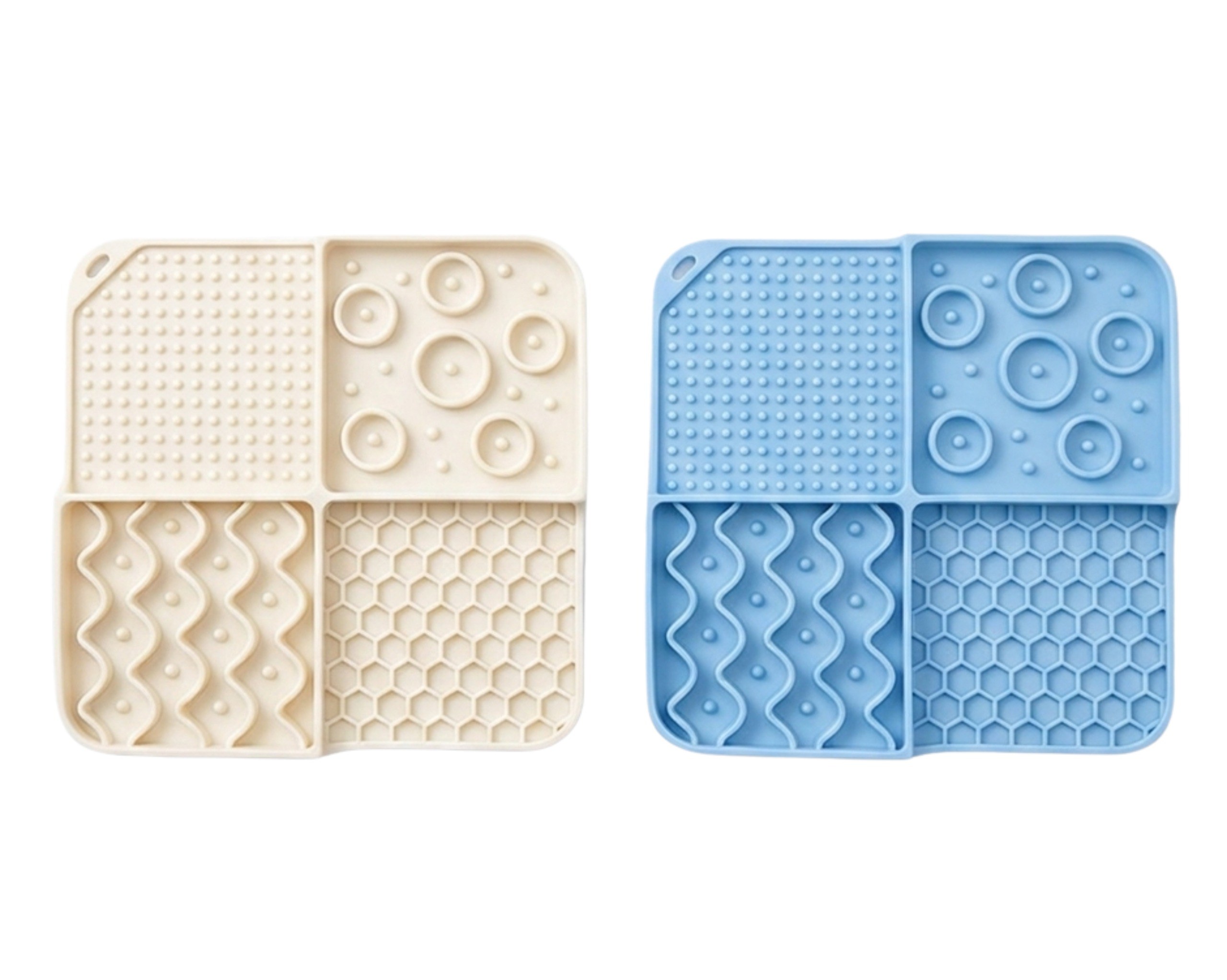
Two mats. Different textures. Rotated. This is not a commercial convenience. It is the correct application of habituation theory to lick mat protocol design.
The PAXA Solo 30-day protocol introduces the Pavlovian safety cue in the third phase. The lick mat is the physical anchor for this cue: high-value food spread on the mat signals departure — and conditions the amygdala to associate leaving with the most rewarding experience in the dog's day. Two mats, rotated to maintain novelty, sustain this conditioning across the full cortisol window.
This is why the PAXA Calm Mat comes as a bundle of two.